Build a faceless digital marketing system with a reusable AI presenter, original visuals, editable storyboards, and one consistent voice.
Step 1: Define the audience, offer, and privacy boundary
Start with the business decision that the content must support. Write down one audience, one recurring problem, one offer, and what you will keep private. A common failure is to publish motivational clips first and decide what they should sell later.
Illustrative example: A solo marketer sells a $19 inventory spreadsheet to first-time Etsy sellers. The creator will not show their face or use their natural voice, but will publish under a real business name and disclose affiliate links. This produces a clearer brief than "make a viral faceless video."
APOB helps after this brief is set: the audience problem becomes the storyboard topic, while details about the offer, proof, tone, and prohibited claims go into the relevant information field.
Step 2: Create a reusable fictional presenter
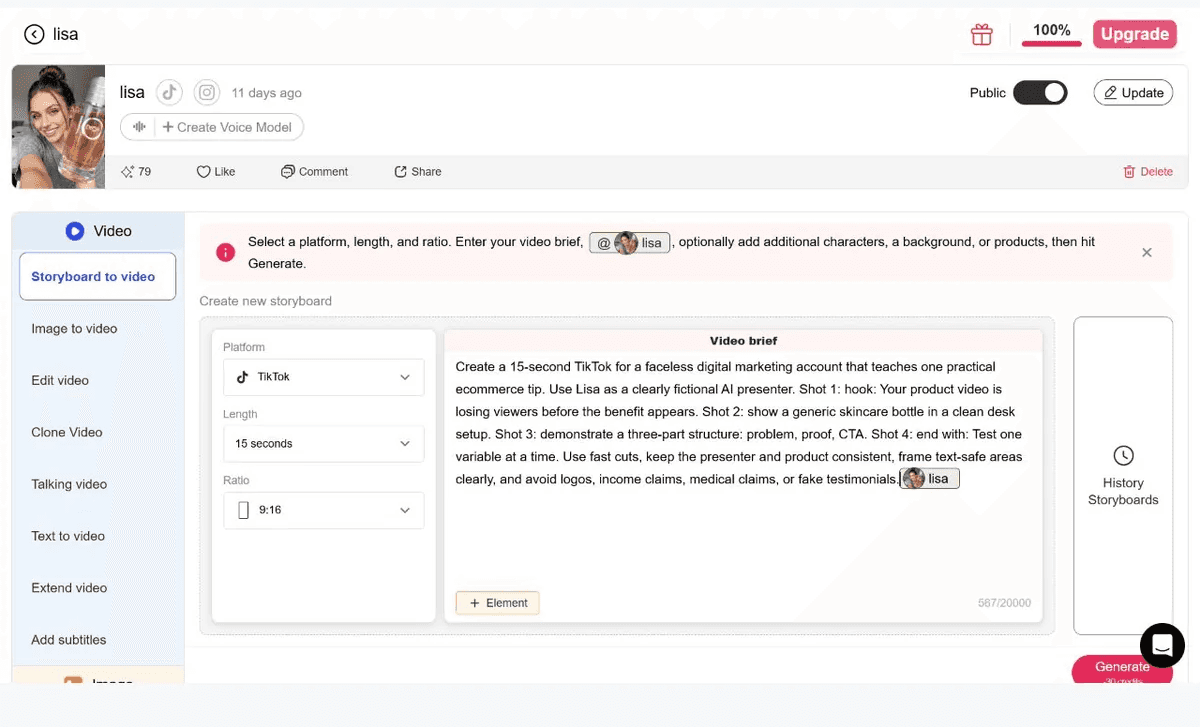
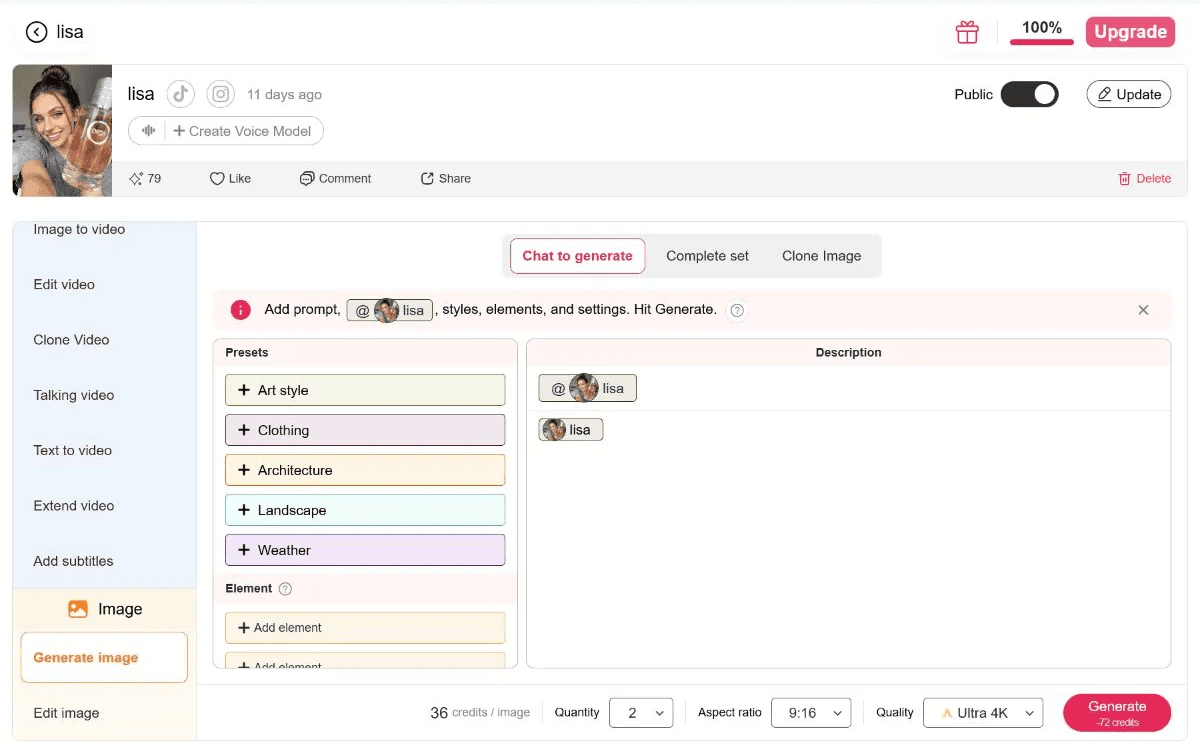
In APOB, create a Portrait Model from one clear reference image or use the built-in AI Influencer Generator to design a fictional face. Name the model and let it train before using it in the workstation. A sharp, well-lit reference with an uncluttered background gives the model a cleaner identity to repeat. See APOB's Portrait Model guide.
Problem solved: Random faces make a feed look like unrelated advertisements, while using a real person's image without permission creates legal and reputational risk.
Illustrative example: The Etsy education brand creates "Maya," a fictional operations guide with a practical wardrobe and neutral studio setting. Maya is presented in the profile bio as a virtual host, not as an actual shop owner or customer.
Step 3: Turn one campaign idea into a platform-ready storyboard
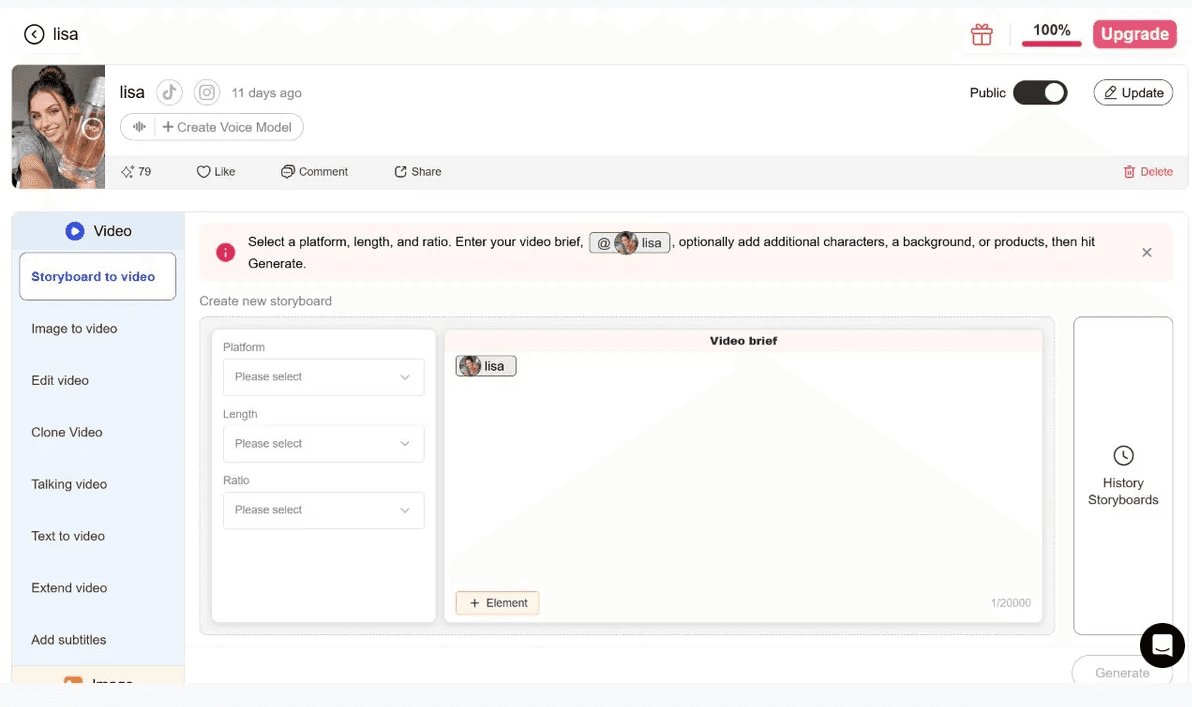
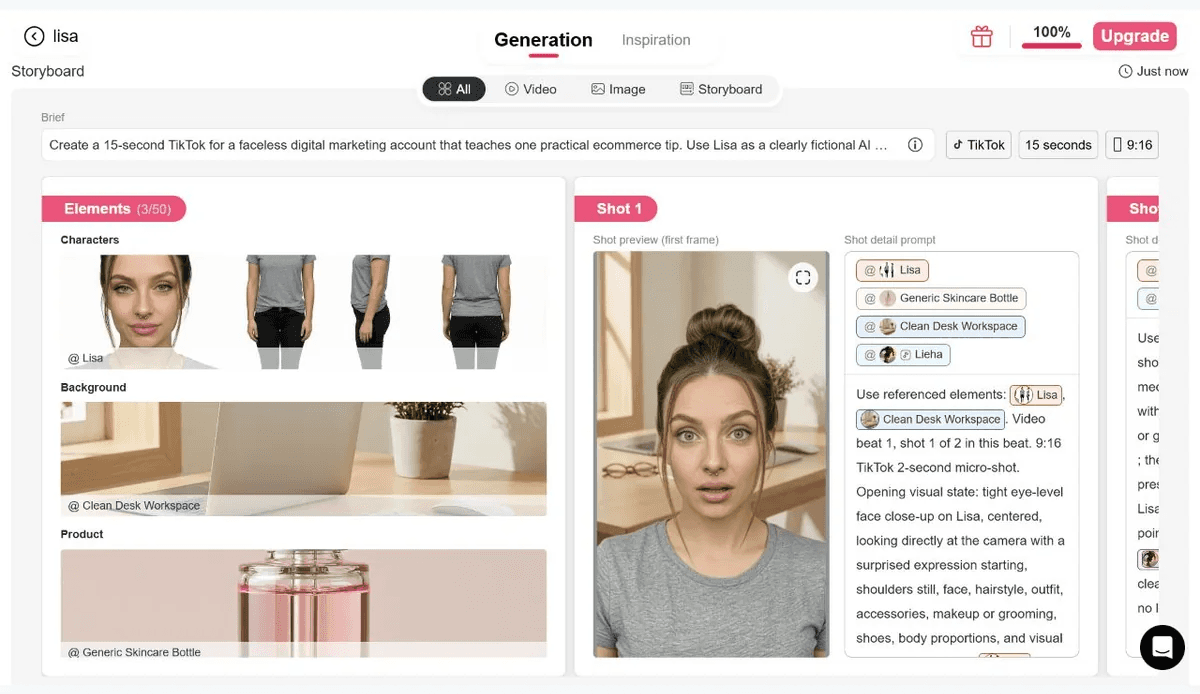
Open AI Storyboarder and create a new Storyboard to Video project. Choose the destination platform, target length, aspect ratio, topic, and relevant information. APOB currently supports planning for TikTok, Instagram Reels, YouTube Shorts, and YouTube, with common lengths and aspect ratios including vertical 9:16. The selected model supplies the recurring look. See Creating a Storyboard from Scratch.
Problem solved: A single long prompt often produces a clip with no clear hook, proof, or call to action.
Illustrative example: For a 15-second Reel, enter the topic "Three inventory errors that quietly reduce Etsy profit." Add relevant information: "Target first-time handmade sellers. Show the spreadsheet only in the final two shots. Use specific examples, avoid income guarantees, and end with 'See the template in bio.'"
Step 4: Keep the cast, setting, and product consistent with Elements
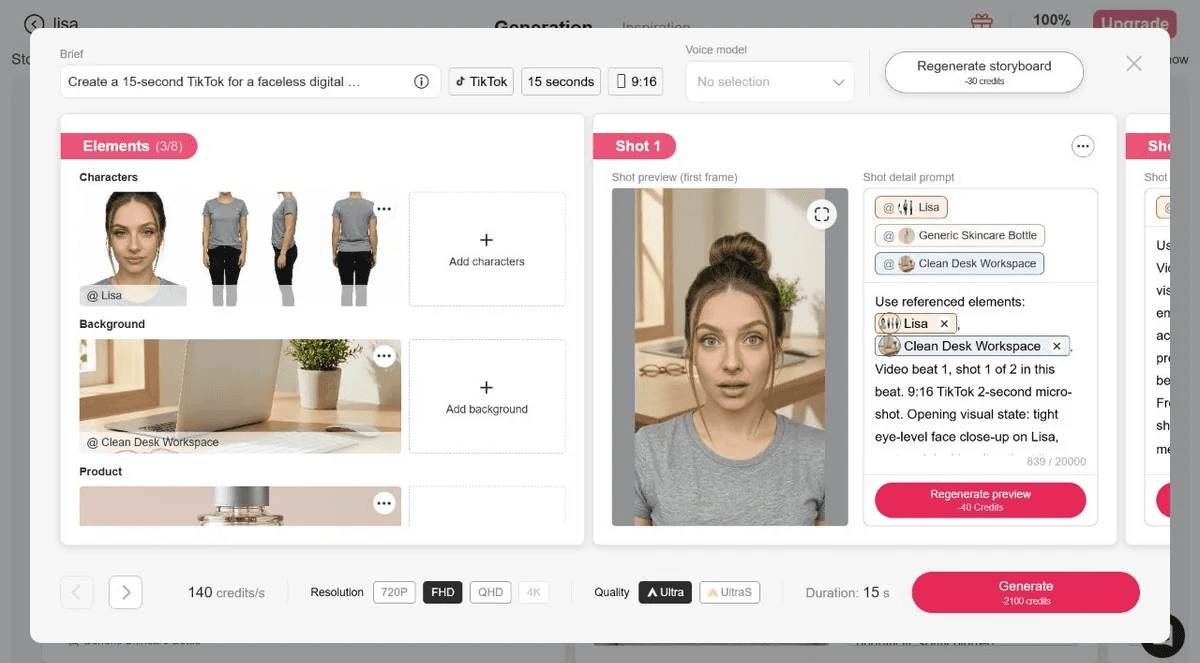
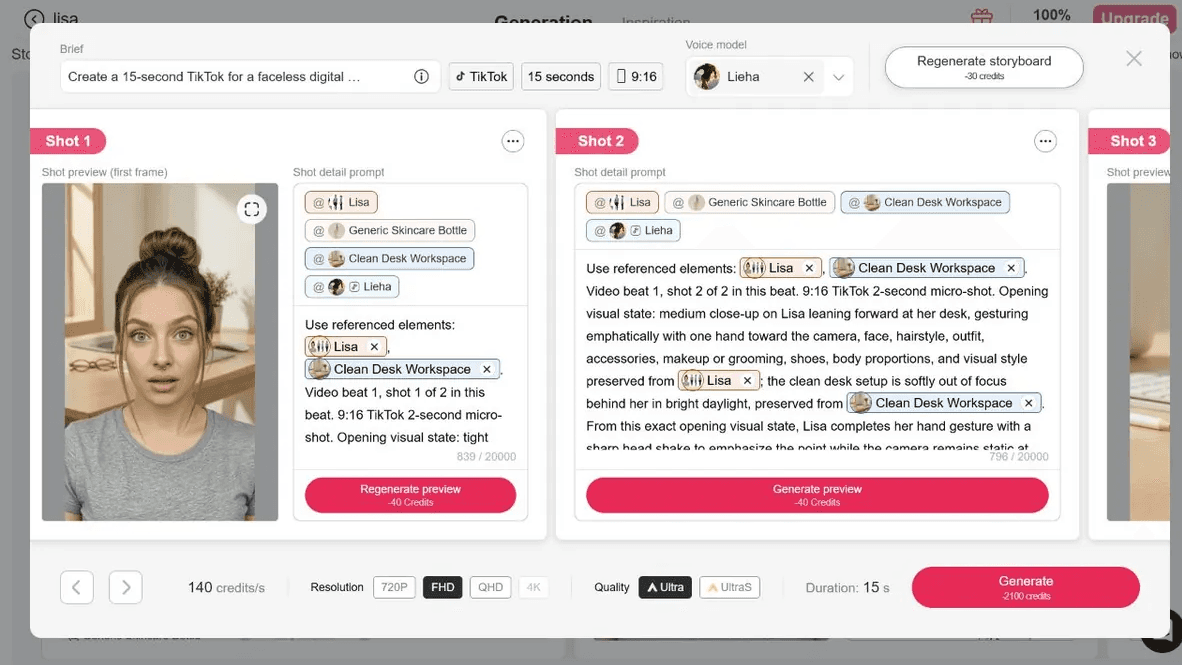
Add reusable Elements for characters, backgrounds, and products, then reference them inside shot prompts with @ mentions. APOB allows up to three Elements in each category for a storyboard, and one Element can be used across multiple shots. See Elements in Storyboard to Video.
Problem solved: The presenter, packaging, or workspace can drift from one scene to the next, weakening brand recognition.
Illustrative example: Add Maya as the character, a compact packing desk as the background, and the inventory spreadsheet shown on a tablet as the product. Reference only the needed Elements in each shot instead of describing them from scratch every time.
Step 5: Write shots that each perform one job
Treat every shot as a small unit: hook, problem, example, proof, or CTA. APOB shot prompts accept up to 500 characters, play from left to right, and save automatically. You can add or delete shots before final generation. See Editing Shots in the Storyboard.
Problem solved: Faceless videos often become a stream of attractive images with no argument.
Illustrative example: Shot 1 shows an overfilled supply shelf and the line "Buying more stock is not the same as making more profit." Shot 2 isolates a duplicate purchase. Shot 3 shows an expired material. Shot 4 shows the spreadsheet flagging both problems. Shot 5 gives the CTA.

Step 6: Choose one narration voice and review the script aloud
A storyboard uses one shared voice model, and a voice is required before the final video can be generated. Select a suitable model from the workflow or prepare narration with the AI Voice Generator, then check names, product terms, numbers, and pauses before rendering. See Choosing the Voice Model.
Problem solved: Switching voices between scenes breaks continuity, while an unchecked script can mispronounce a brand or make a short video sound rushed.
Illustrative example: Use a calm, direct voice across the Etsy series. Rewrite "SKU reconciliation" as "checking stock records" if the technical term sounds unnatural for beginners. If you clone a real voice, obtain explicit permission first.
Step 7: Check the sequence before the final render
Confirm that every shot has a prompt, the voice model is selected, and the total duration fits the promise made in the hook. Set resolution and quality, review the credit cost displayed on the Generate button, and render the final video. APOB calculates cost from duration, resolution, quality, and plan. Once a final video is generated, that storyboard becomes view-only; use Regenerate or Recreate to make a fresh editable version. See Generating the Final Video.
Problem solved: Rendering before checking the order wastes credits and can lock in a weak CTA or unsupported claim.
Illustrative example: The marketer notices that the product appears before the viewer understands the inventory problem. They revise the earlier shot prompts to explain the problem first, keep the product reveal near the end, then generate.

Step 8: Publish one series, measure it, and revise the next storyboard
Export the finished asset and complete any final caption, music, disclosure, and platform checks. Measure the result against the job of the post: average watch time for an educational Short, saves for a checklist, qualified clicks for a product demo, or completed leads for a service explainer.
Illustrative example: If the "duplicate supplies" hook earns more saves than the "expired materials" hook, the next storyboard can expand the first problem into a three-part series. The virtual presenter remains consistent while the lesson changes.
Next step: Plan your first multi-shot video with APOB AI Storyboarder.
Copy-Ready Prompts for APOB Storyboards
These prompts are written as complete production briefs. Paste the short line into Topic and the longer block into Relevant info.
Ecommerce seller: problem-solution product Reel
Purpose: Introduce a reusable water bottle through a real use problem rather than a fake customer endorsement.
Topic:
A commuter hydration routine using a marked water bottle
Relevant info:
Create a 20-second 9:16 Instagram Reel for commuters who forget to drink water at work. Use a fictional virtual presenter in a bright train-station setting. Open with a visual of a full bottle returning home untouched. Show three practical reminder moments: leaving home, arriving at a desk, and the mid-afternoon break. Present the marked water-level bottle only as the tool that supports the routine. Do not claim health outcomes or quote a customer. End with: "Build the reminder into the bottle. See the colors in our shop."
Expected output: A five-shot product story with a problem-led hook, consistent bottle appearance, and a non-deceptive CTA.
Digital-product creator: educational YouTube Short
Purpose: Teach one useful idea before offering a template.
Topic:
Define revision rounds in a freelance design proposal
Relevant info:
Create a 30-second 9:16 YouTube Short for new freelance designers. A fictional virtual operations coach explains why "two rounds of revisions" needs a definition in a proposal. Shot 1: a client asks for "one tiny change" for the fifth time. Shot 2: show the vague clause. Shot 3: replace it with a clause that defines one round as one consolidated list of changes. Shot 4: explain that extra rounds require written approval and a fee. Shot 5: show a proposal-template preview and say, "Use the clause as written or adapt it to your policy." Avoid legal advice claims.
Expected output: A complete micro-lesson with a concrete before-and-after example and a soft product transition.
SaaS marketer: screen-led feature tutorial
Purpose: Combine a stable narrator with interface evidence.
Topic:
Find the most common return reason in an ecommerce dashboard
Relevant info:
Create a 25-second 9:16 TikTok for small ecommerce teams using a returns dashboard. Use a fictional virtual presenter only in the opening and closing shots. The middle shots should focus on a clean screen demonstration: filter returns by reason, identify the most common size issue, and export the list for the product team. Keep all interface labels readable. Do not invent performance improvements. End with: "Find the return reason before changing the product page."
Expected output: A host-led tutorial that keeps the product interface, not the AI character, as the proof.
Affiliate marketer: transparent comparison video
Purpose: Recommend a tool while making the commercial relationship clear.
Topic:
Compare password-manager access features for remote teams
Relevant info:
Create a 30-second 9:16 Instagram Reel comparing two password-manager features for remote teams: shared vault permissions and emergency access. Use an abstract digital-security setting and a fictional narrator. Put "Affiliate link: I may earn a commission" on screen before the first recommendation and repeat it in the closing frame. Compare only documented features. Do not say either tool is unhackable or guarantee security. End with: "Choose based on who needs access and how recovery should work."
Expected output: A balanced comparison with a visible disclosure, verifiable criteria, and no absolute security claim.
Agency creator: three-hook ad test
Purpose: Generate controlled creative variants for a local cleaning service.
Topic:
Three controlled ad hooks for a home-cleaning consultation
Relevant info:
Create three 15-second 9:16 social-video storyboards for the same home-cleaning consultation. Use one fictional virtual host, one modern kitchen background, the same calm voice, and the same final CTA: "Check availability for your postcode." Variant A opens with pet hair returning after vacuuming. Variant B opens with the time lost cleaning before guests arrive. Variant C opens with confusion about what a deep clean includes. Keep the service description identical after the hook. Do not show fake cleaners, fake reviews, or guaranteed time savings.
Expected output: Three comparable concepts in which the hook is the main variable.
Stay off camera without losing a recognizable host
A recurring fictional presenter gives viewers a visual anchor without requiring the founder to film. This is useful for creators with privacy concerns, distributed teams, or a brand that should not depend on one employee's availability.
Replace generic stock montages with original scenes
Stock footage is quick, but the same clip may appear on dozens of accounts. Custom characters, products, and backgrounds make a campaign easier to distinguish and let the visuals respond to the actual script.
Plan for the destination platform before generating
Platform, length, and aspect ratio are selected when the storyboard is created. A 15-second 9:16 TikTok brief should not be treated like a landscape YouTube explainer and cropped as an afterthought.
Maintain continuity across multiple shots
Shared Elements and one storyboard voice reduce accidental changes in the presenter, setting, product, and narration. Consistency matters more when the creator's own face is not available as the brand marker.
See generation cost before committing
APOB displays the credit cost at the point of generation. The platform uses a credit system, and the exact amount varies by action, duration, resolution, quality, and account plan. Current plan details are documented in Credits, Plans & Billing.
Keep the human judgment that trust requires
AI can support production, but it should not invent product proof, customer experiences, qualifications, or earnings. This is especially important because IAB found a significant gap between advertiser and consumer attitudes toward AI-generated advertising. The same research recommends using AI to improve creative quality and applying consistent disclosure practices, not treating automation as a substitute for judgment. Read the IAB study.
The following are illustrative workflows, not customer case studies or income claims. For broader market context, IAB projected US creator ad spend at $37 billion in 2025, up 26% year over year, and expected it to reach $44 billion in 2026. Three in four surveyed brands were using or planning to use AI for creator-marketing tasks. IAB Creator Economy Ad Spend & Strategy Report. These figures describe creator advertising as a whole; they are not a measurement of the faceless digital marketing category.
Ecommerce: a virtual host demonstrates one product problem
A small skincare seller can use the AI Product Video Generator to create a 20-second vertical concept in which a fictional host compares the amount of moisturizer needed in dry and humid conditions. Product Elements keep the jar consistent while close-up scenes show texture and packaging. The script should use substantiated product facts, not a fabricated testimonial.
Best outcome to measure: Product-page visits, qualified comments, and add-to-cart rate rather than raw views alone.
SaaS: an off-camera product tip with a branded narrator
A project-management company can combine a virtual host with interface recordings. The host introduces the problem, the screen capture demonstrates the feature, and the final shot returns to the host for a specific CTA. The founder never appears, but the company remains identifiable.
Best outcome to measure: Feature adoption, demo clicks, or help-center visits from the post.
Digital products: a lesson that leads naturally to a template
A creator selling a freelance proposal template can publish a weekly series on scope, pricing, and revisions. Each video gives one complete lesson before showing the template. This avoids the common faceless-marketing pattern of repeating "make passive income" claims without demonstrating useful expertise.
Best outcome to measure: Saves, email sign-ups, and sales from a tagged link.
Agency campaigns: multiple concepts without scheduling a spokesperson
A small agency can test three hooks for the same local-service offer using one approved virtual host and one product brief. Only the opening problem changes. This makes the experiment easier to interpret because the character, voice, and core offer remain stable.
US digital video ad spend is projected to surpass $80 billion in 2026, with social video growing faster than connected TV in IAB's forecast. IAB Digital Video Ad Spend & Strategy Report. That scale makes systematic creative testing more useful, but every version still needs human review.
Multilingual education: localize the presenter, not the facts
A travel-app team can adapt a short packing checklist for different language audiences while retaining the same virtual host and visual sequence. Each localized script should be checked by a fluent reviewer for pronunciation, cultural context, and claims.
Best outcome to measure: Completion rate and app clicks by language, with each version tracked separately.

Sasha Kim
I turned one newsletter idea into a faceless vertical video without setting up a camera. The voiceover and visual sequence gave me a solid draft, and I only changed the opening to make the benefit clearer.

Evan Cole
For a small ecommerce brand, I made a product explainer using close-up visuals and narration instead of a presenter. It felt more polished than a slideshow and was much easier to update when the price changed.

Amara Okafor
I repurposed an older SEO article into three short social concepts. Not every section deserved a video, but the workflow helped me find the practical tips that could stand on their own.

Julian Park
I do not enjoy being on camera, so consistent faceless content used to be a struggle. Using a recurring visual style and the same tone of voice finally made the posts feel like one brand.

NoFaceNeeded
A software tutorial needed a quick social teaser. I combined product screens with a short voiceover and kept the founder off camera. The result explained the use case without feeling anonymous or vague.

ContentBatcher
I used APOB for a faceless comparison ad where the product, not a spokesperson, stayed central. Specific scene prompts made it feel credible; generic 'marketing' language produced much weaker visuals.

QuietLaunchCo
For client content, the biggest benefit is being able to revise the script without arranging another recording. I changed one claim and regenerated the narration workflow before the campaign review.

EvergreenFunnel
I built a simple educational series with an AI character and consistent backgrounds. The visual identity made the account feel recognizable even though there is no real host on screen.

SoloGrowthDesk
Faceless does not mean effortless, but it removes the filming bottleneck. I still plan the hook, proofread the script, and check every visual, yet I can publish useful content on a realistic schedule now.
More control over personal exposure. The founder can keep their face, home, routine, and natural voice out of public content while operating under a legitimate brand identity.
A reusable brand character. A fictional presenter can return across campaigns even when a team member leaves or is unavailable for filming.
Fewer reshoots. Copy, shots, products, and narration can be revised in a digital workflow without rebuilding a physical set.
Clearer series production. Content pillars and storyboard templates make it easier for several contributors to follow the same voice and visual rules.
Useful for visual and instructional offers. Ecommerce demonstrations, software walkthroughs, explainers, checklists, and entertainment formats do not always need a real host.
Trust may take longer. Without a real person on screen, proof must come from accurate demonstrations, sources, transparent policies, and consistent delivery.
AI assets can feel interchangeable. A generic voice, broad script, or overused visual style can make one account indistinguishable from another.
Generation still requires review. Faces, hands, product labels, interface text, timing, and pronunciation can be wrong even when the first preview looks plausible.
Not every offer suits anonymity. High-trust consulting, regulated advice, personal coaching, and founder-led communities may benefit from a real expert being visible.
Credits and iteration affect cost. Longer videos, higher quality, and repeated generation consume more credits, so a clear brief and pre-render review matter.
No Credit Card Required




Answers about strategy, APOB workflows, costs, commercial use, privacy, disclosure, and platform compatibility.
What is faceless digital marketing?
It is the practice of marketing a product, service, or idea without making the creator's real face or personal identity the center of the content. Common formats include screen recordings, product demonstrations, narration, generated scenes, text-led videos, and clearly fictional virtual presenters.
What is the difference between faceless digital marketing and personal branding?
Personal branding builds recognition around a real individual's identity, experience, and public presence. Faceless marketing builds recognition around the topic, visual system, offer, or disclosed virtual presenter. Both still require accurate claims and a consistent point of view.
How does faceless digital marketing work?
The creator selects a niche and offer, builds a recognizable brand system, publishes useful content, and sends interested viewers to a defined next step. The business still needs accurate claims, customer support, and a real conversion path; removing the creator's face does not remove those responsibilities.
Is faceless digital marketing legitimate or a scam?
The marketing model is legitimate. The risky part is the way some people sell it through guaranteed-income claims, copied content, fake testimonials, or resale courses with no real value. Evaluate the offer, evidence, disclosures, and business economics rather than the "faceless" label.
How do I start faceless digital marketing as a beginner?
Choose one audience problem, one offer, one primary channel, and two or three repeatable content formats. Produce a small series, measure qualified actions, and improve the next series. Avoid buying a large tool stack or posting generic clips before the offer is clear.
Do I need a faceless digital marketing course?
No. A course may provide structure, but it is not required to create useful content or test an offer. Start with platform documentation, a simple content plan, and a small production workflow. Be cautious with courses that emphasize income screenshots more than customers, costs, and execution.
What are good faceless digital marketing examples?
Useful examples include a screen-recorded SaaS tutorial, a product close-up narrated by a virtual host, an animated data explainer, a hands-only craft demonstration, a branded checklist video, or a fictional AI presenter introducing an ecommerce collection.
Can I use an AI influencer for a faceless brand?
Yes. A fictional AI influencer can act as the public host while the operator remains off camera. Keep the character visually consistent, disclose its synthetic nature when required or likely to affect trust, and never imply that it is a real customer or licensed professional.
Can I use APOB AI for free?
APOB has a free Nano plan with a daily credit refill. Generation and editing actions consume different amounts, and limits or included features can change. Check the cost shown before generating and review the current Credits, Plans & Billing guide.
How much does a faceless marketing video cost in APOB?
There is no single price per video. Credit use depends on the workflow, duration, resolution, quality, and account plan. APOB displays the applicable credit cost near the Generate button before the action is confirmed.
Can I use APOB-generated content commercially?
APOB is designed for legitimate commercial and creative uses, including marketing and social content. Commercial use remains subject to the current Terms of Service, your rights to every input, applicable law, and third-party rights. Review those conditions for each campaign rather than treating AI output as automatically cleared.
Will a virtual presenter stay consistent across videos?
A trained Portrait Model provides a reusable character, and Storyboard Elements help keep recurring characters, backgrounds, and products consistent within a project. Results still need visual review, especially when poses, angles, clothing, or lighting change substantially.
Do I have to use an AI voice?
No. The wider faceless strategy can use your own authorized narration, licensed audio, text-led content, or a suitable voice model. In APOB's Storyboard to Video workflow, a voice model is currently required for the final narrated video.
Can I publish the same video on TikTok, Reels, and YouTube Shorts?
You can adapt the same concept, but check each platform's duration, safe zones, captions, music license, disclosure controls, and audience expectations. A platform-specific opening and CTA usually performs a more useful test than uploading an identical file everywhere.
Can APOB AI publish or schedule my social media posts?
No. APOB creates images, videos, virtual presenters, voiceovers, and storyboard assets. Publishing, scheduling, community management, landing pages, email automation, and analytics remain part of the wider marketing stack.
Does labeling AI content reduce reach?
Do not avoid a required label based on reach speculation. TikTok states that turning on its AI-generated content setting does not affect distribution as long as the post follows its guidelines, and YouTube states that disclosure does not by itself limit audience or monetization eligibility.
How do faceless brands build trust without a real spokesperson?
Use accurate demonstrations, cite sources, show limitations, disclose commercial relationships, publish contact and policy information, and keep the visual and editorial voice consistent. Trust comes from verifiable behavior, not merely from adding a human-looking avatar.
Can faceless digital marketing make money?
It can support sales, affiliate commissions, leads, sponsorships, subscriptions, or platform revenue, but the format does not guarantee income. Results depend on demand, offer quality, distribution, costs, conversion, and compliance. Treat views as attention, not profit.
Is my uploaded content private?
Privacy depends on account settings and the current policy. APOB offers public/private controls for certain models and content, with some private features tied to paid plans. Do not upload material you are not authorized to process, and review the latest Privacy Policy and plan settings before using sensitive assets.
What should I review before publishing an AI faceless marketing video?
Check the hook, factual claims, product appearance, spelling, pronunciation, subtitles, music and image licenses, sponsorship disclosure, AI-content label, CTA destination, and platform format. Watch the entire exported file once with sound and once muted.
Ready to create the first asset in your faceless content system? Start creating with APOB AI.


