An AI KPOP idol is an original K-pop-inspired character made with AI-generated portraits or clips. Give yours a recognizable face, then build a debut reveal, a two-look photocard set or a short teaser around it. Start with 80 daily credits on APOB's free Nano plan. Sign-in is required; generation costs vary. Free downloads are watermarked, and private creation requires paid access.
1. Choose the face before the stage concept
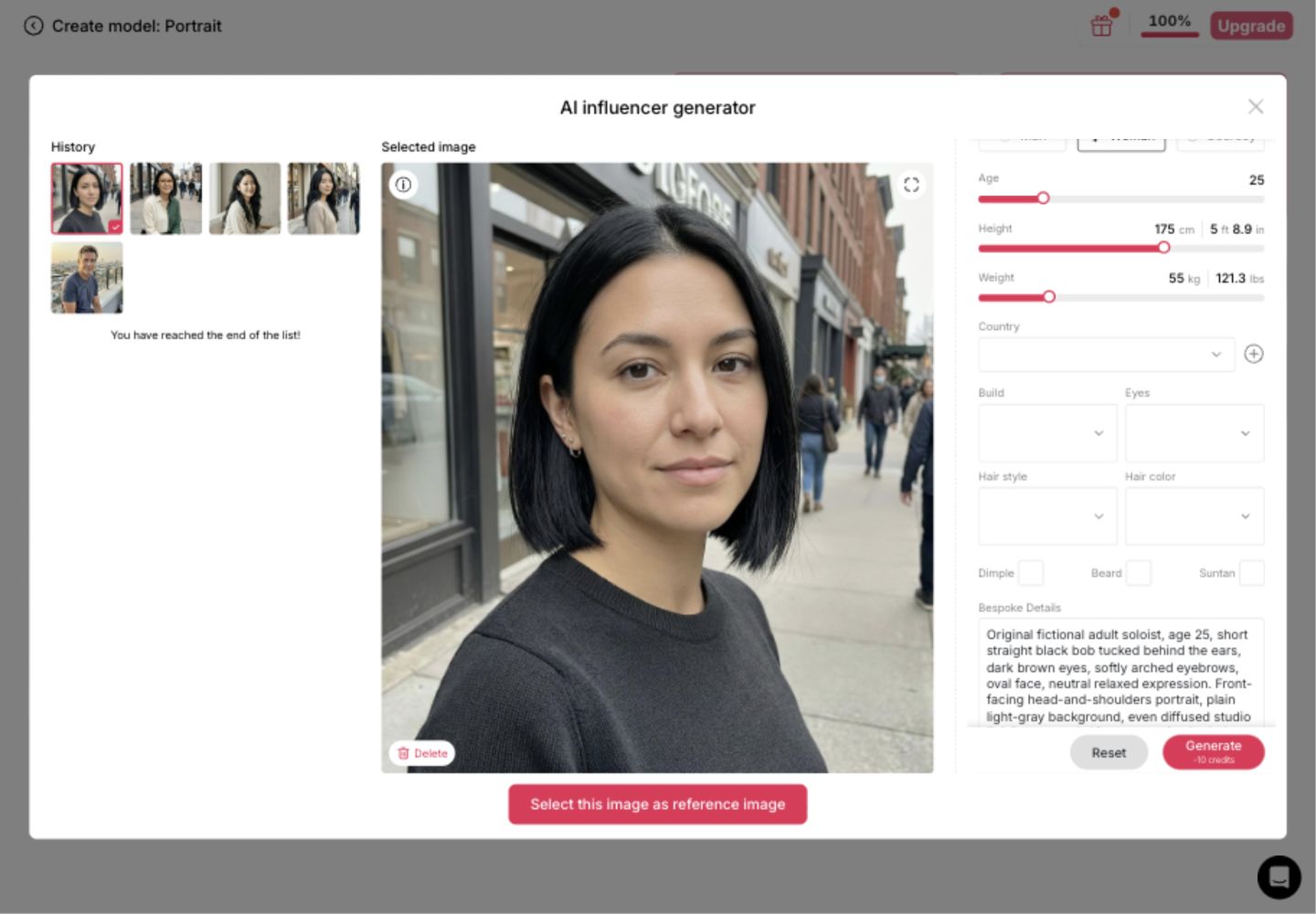
Sign in at app.apob.ai and select Create Portrait Model. On Create model: Portrait, choose Click to upload image for your own photograph or a likeness you have explicit, verifiable permission to use. For a fictional character, open AI influencer generator, set an adult age and enter the face description in Bespoke Details. Prompt 1 below is ready to paste.
Select Generate, wait for a completed result in History, click it to inspect Selected image, then choose Select this image as reference image. An unfinished or unselected image cannot be used yet.
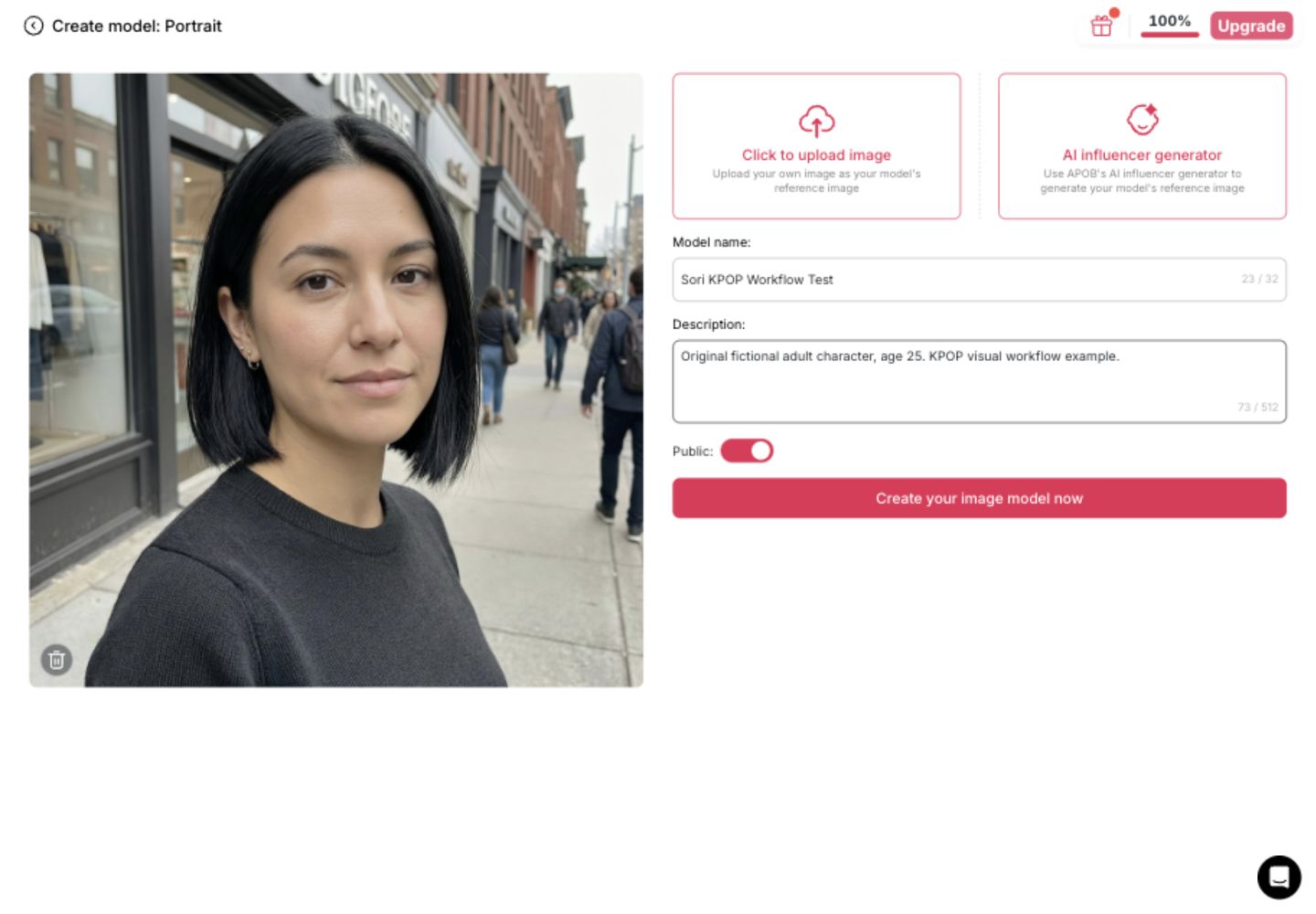
Example: Our Sori reference used age 25, a short black bob and softly arched eyebrows. The generator supplied an unobstructed face but an outdoor street instead of the requested gray studio. Evaluate the face and background separately; do not accept a result solely because generation finished. For an upload, start with one sharp, well-lit face and a simple composition. Reference image guidance.

2. Name the model and check who can see it
Enter a Model name, add an optional Description, review Public, and select Create your image model now. Wait for the model to become ready, then open its workstation. Keep the model name short enough to recognize in the selected-character chip.
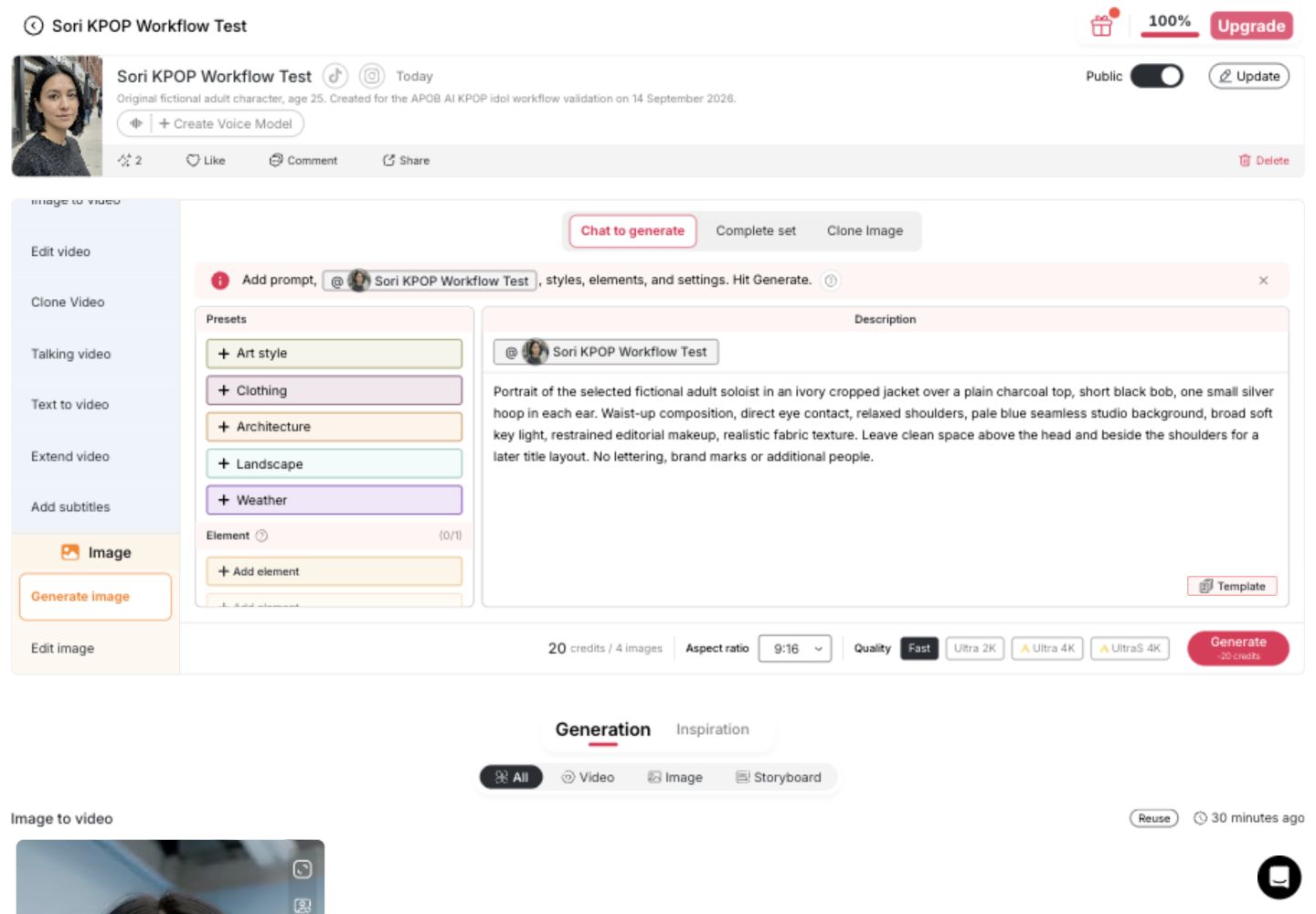
Example: The screenshots use “Sori KPOP Workflow Test,” an original adult character. The Public switch is on. A personal-photo project needs the same visibility check before creation; private models require a paid plan. If the create button is inactive, confirm that you are signed in and have both a reference image and a name. The name field accepts up to 32 characters. Model setup and visibility.
Reuse the saved model for later looks. Creating another model for every outfit wastes model slots and makes identity comparison harder.
3. Generate one controlled debut concept
Choose Generate image, confirm the Sori model chip, and paste prompt 2 into Description. Set Aspect ratio and Quality for the intended asset, read the quote beside Generate, then submit. In our test, Fast, 9:16 displayed 20 credits / 4 images. Treat that as a dated example; available modes and prices can change.
Example: The debut brief requests an ivory jacket, charcoal top, waist-up framing and a pale blue background. For a second concept, keep the reference and framing and change only the background and lighting. This makes it easier to judge whether the same character still reads clearly.
Wait for finished images in Generation before selecting the strongest candidate. A model chip identifies the intended reference; it does not guarantee every output matches it exactly. Workstation controls.


4. Correct the selected image before downloading
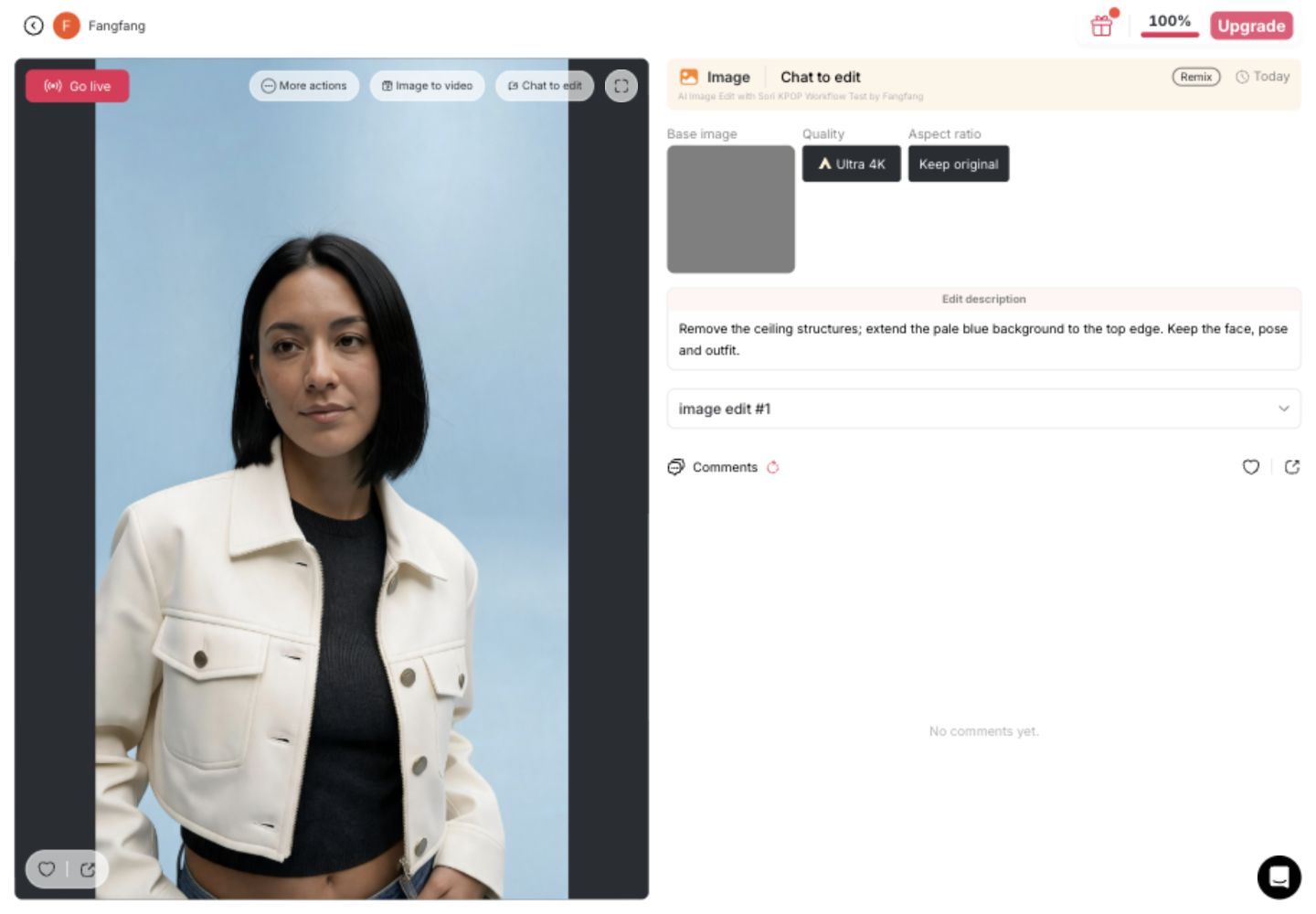
Inspect a completed image at full size. To repair a specific defect, open Edit image → Chat to edit, choose Base image → Select content, select your result and enter an Edit description. Check the quality, aspect ratio and quoted cost before generating the edit. The result page shows the edit instruction alongside the output.
Example: Three images in our four-image debut batch included ceiling structures above the backdrop. We selected an affected portrait and entered: “Remove the ceiling structures; extend the pale blue background to the top edge. Keep the face, pose and outfit.” The completed edit removed the visible ceiling structures. The screenshot shows that actual result; recheck identity after any edit.
Before saving, check the face against the reference, inspect jewelry and garment edges, and preview the intended crop. Add exact nameplates or photocard borders in a design editor.
For saved work, use History → My → Contents. APOB's History guide explains Select → choose items → Download. Free downloads are watermarked; decide on final-file requirements before generating campaign assets. Download rules.
5. Turn an approved portrait into an optional teaser
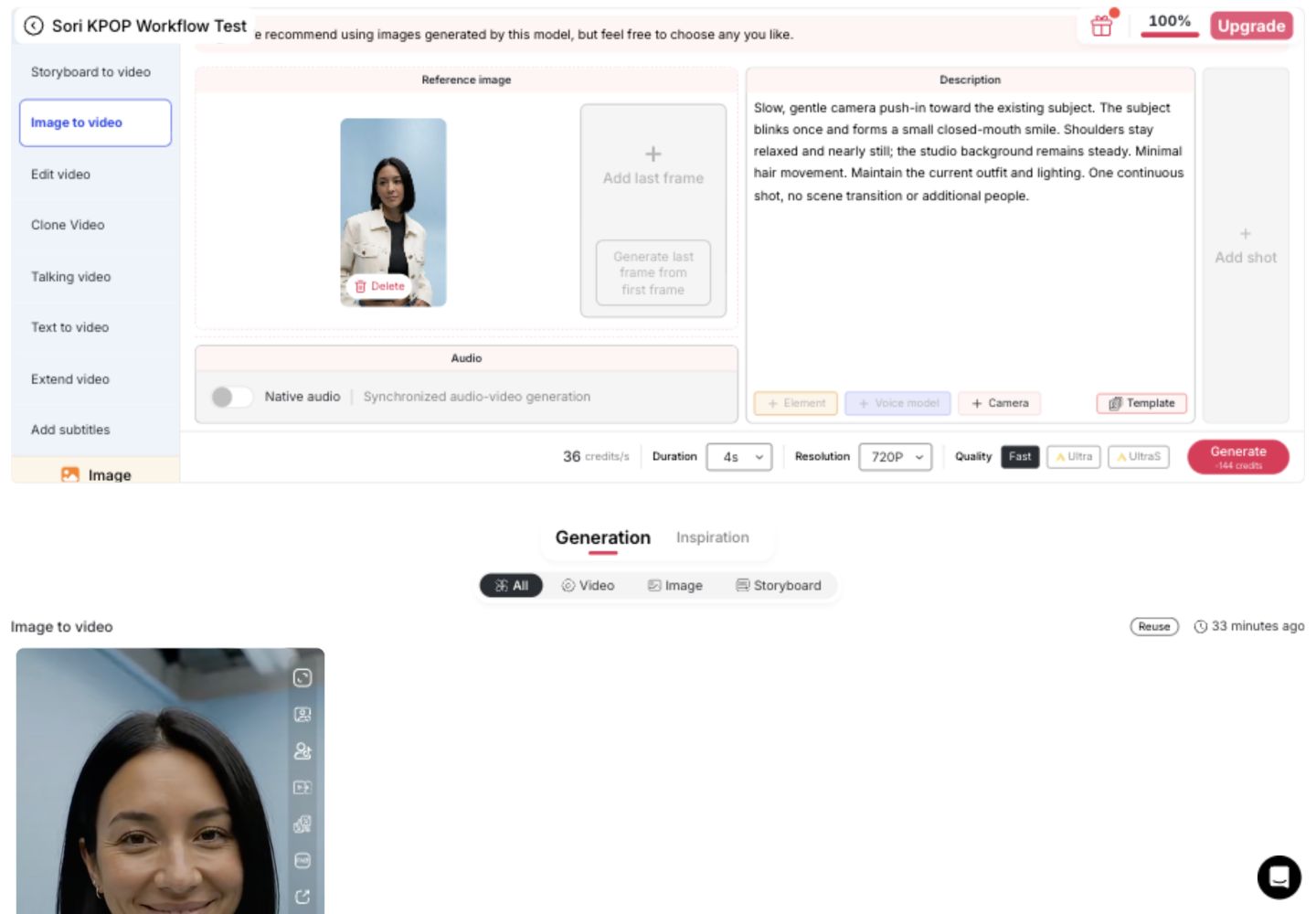
In the model workstation, choose Image to video → Reference image → Select content and select the corrected portrait. Paste prompt 5 into Description. Check Duration, Resolution, Quality and Native audio separately. The screenshot shows Fast, 4s, 720P, native audio off, with a 144-credit quote. Select Generate only after checking your available balance.
Example: Start Sori's reveal with a gentle push-in, one blink and a small smile. Our earlier test used an uncorrected portrait: sampled playback retained the ceiling and showed teeth despite the closed-mouth instruction. The pictured setup now selects the corrected still for the next attempt. Inspect the complete clip before release; a motion prompt will not reliably repair the starting image.
For speech instead of a silent reveal, use Talking video → Talking Avatar with a permitted voice and a short Script, or authorized recorded audio. Prompt 6 provides an introduction. Talking Avatar guide.
Create one original adult character, approve the first portrait, then choose the next asset: a second concept, a photocard image or a short introduction.
Build Your First Idol Reference
80 daily credits on Nano. Costs vary; free downloads are watermarked. See current plan conditions before generating final assets.


6. Plan a four-member girl-group concept
Give each original adult member a distinct face, hairstyle and outfit, then repeat one lighting and color brief across the set. Check your plan’s portrait-model allowance before creating separate members. Generate and approve their portraits individually, then arrange the selected images together in a design editor. A single group prompt does not guarantee four consistent identities.
Example: Build a black-and-pink debut lineup with a tailored black suit, a vivid pink jacket, a black sequined jacket and a long leather coat. Use long black hair, a blonde ponytail, chestnut waves and a short bob to distinguish the four members while keeping the magenta stage lighting consistent.
Visual brief: The four-member image is editorial concept artwork, not a tested multi-person APOB output. Use it to plan the styling, spacing and color palette; compare each finished member portrait with its own reference before assembling the group.
Expert prompts for AI KPOP idol content
Checked 14 September 2026: This AI-assisted guide includes real APOB interface screenshots and a signed-in test of prompts 1, 2 and 5, plus the step 4 edit. Prompts 3, 4 and 6 are suggested briefs, not tested results. View the Sori test model (sign-in may be required).
Use each prompt in its specified image, motion or audio input. Set quality, ratio and other controls separately.
1. Establish the original adult reference
Purpose: Build a clear identity before adding stage styling. Input: No selfie needed. APOB mode: AI influencer generator; set the adult age in the interface and enter the description in Bespoke Details.
Original fictional adult soloist, age 25, short straight black bob tucked behind the ears, dark brown eyes, softly arched eyebrows, oval face, neutral relaxed expression. Front-facing head-and-shoulders portrait, plain light-gray background, even diffused studio lighting, natural skin texture, simple dark crew-neck top, face unobstructed, no text or logos.
Intended output: A neutral portrait suitable for selecting a character reference. Observed: The selected result had the short bob and an unobstructed face, but placed the subject on an outdoor street instead of the requested gray studio background. Check: Evaluate the face and scene separately; a useful face reference may still need a new setting for the debut portrait.
2. Create the debut reveal portrait
Purpose: Introduce the character with a defined visual theme. Input: Your selected adult portrait model. APOB mode: Generate Image.
Portrait of the selected fictional adult soloist in an ivory cropped jacket over a plain charcoal top, short black bob, one small silver hoop in each ear. Waist-up composition, direct eye contact, relaxed shoulders, pale blue seamless studio background, broad soft key light, restrained editorial makeup, realistic fabric texture. Leave clean space above the head and beside the shoulders for a later title layout. No lettering, brand marks or additional people.
Intended output: A debut portrait with room for later typography. Observed: The batch followed the broad outfit and palette, but faces, jacket details and backgrounds varied. Check: Compare with the reference and inspect hidden or malformed earrings. Step 4 shows the background correction we tested.
3. Build a backstage photocard variation
Purpose: Produce a second collectible look without replacing the character. Input: The same portrait model and the debut image for comparison. APOB mode: Generate Image.
The selected adult idol character, same short black bob and ivory jacket, centered chest-up portrait. Charcoal backstage wall, soft violet edge light, gentle warm light across the face, subtle closed-mouth smile. Keep both shoulders inside the frame and generous crop margins. One small silver hoop per ear, simple uncluttered styling, no backstage passes, signage, text or other people.
Intended output: A coordinated second portrait for an externally designed photocard. Check: The new lighting has not obscured the eyes or changed the face beyond recognition.
4. Explore an accessory campaign direction
Purpose: Plan styling for an original fashion editorial. Input: An adult portrait model; an authorized product Element only when the selected mode and quality support it. APOB mode: Generate Image.
Editorial portrait of the selected fictional adult model, hair tucked behind the visible ear, minimalist cream blazer, pale stone background, soft side lighting. Make a simple silver ear cuff the styling focus; keep the ear, jewelry edges and blazer collar clearly visible. Calm expression, natural skin texture, no hands touching the face, no lettering or logos.
Intended output: A styling concept, subject to product-accuracy review. Check: Compare the accessory to the actual SKU. Add the product reference through the supported Element control when available; the text description alone does not reproduce an exact product.
5. Animate a restrained debut teaser
Purpose: Give an approved portrait a small amount of motion. Input: The finished debut portrait. APOB mode: Image to Video.
Slow, gentle camera push-in toward the existing subject. The subject blinks once and forms a small closed-mouth smile. Shoulders stay relaxed and nearly still; the studio background remains steady. Minimal hair movement. Maintain the current outfit and lighting. One continuous shot, no scene transition or additional people.
Intended output: A short reveal clip from the source image. Observed: The test showed a blink, smile and closer framing, with the source-image and expression issues described in step 5. Check: Review face, jewelry and expression through the full clip. This single, sampled test is not a reliability benchmark.
6. Introduce a fictional virtual idol
Purpose: Open a creator's concept-diary series. Input: An approved front-facing portrait and a permitted voice, or authorized recorded speech. APOB mode: Talking Video → Talking Avatar; paste the following into Script when using Create audio.
Hi, I'm Sori, a fictional virtual idol. Welcome to my debut diary. Today I'm trying a blue studio look and a violet backstage look. Which one should return in the next episode?
Intended output: A spoken introduction suitable for captioning and editing. Check: Listen for the character name and natural pauses, then review lip movement. This is dialogue, not an instruction to imitate a real singer.
Return to a defined character
A saved portrait model gives your debut series a common starting point. Reuse it for the profile image, studio concept and backstage look instead of rebuilding the face description from memory. Review the outputs together: a reusable reference supports continuity, but does not guarantee identical features in every image. Explore the broader AI influencer workflow.
Separate the concept decision from the finishing work
Use image prompts to test a color palette or wardrobe direction, then refine the image you choose. For a two-look debut, keeping the composition stable helps you judge whether pale-blue studio lighting or violet backstage lighting suits the character. The prompt composer accepts specific scene directions; treat them as instructions to evaluate, not locked settings.
Start motion from a portrait you already approved
The image-to-video handoff lets you begin a reveal clip with an existing image. This is useful when the photocard and teaser should introduce the same visual identity. Keep motion simple for the first attempt, then inspect the entire clip. See the image-to-video workflow.
Check spending at each creative decision
The generation interface displays a cost before you commit. Use that checkpoint to decide whether another still-image variation matters more than a longer teaser. The daily allowance is a credit budget; it is not a promise of a fixed number of finished assets.
Use an original identity or an authorized likeness
Choose fictional adults for original idol projects. If you use a real face or recorded voice, obtain permission covering the intended use. APOB's terms prohibit using a third party's likeness, voice or persona without explicit, verifiable consent. Do not present a fictional character as a real artist, label representative or celebrity endorsement. APOB Terms of Service.
Check commercial rights beyond the tool
APOB's terms provide for legitimate commercial creation and assign rights in generated models and content to the user to the extent permitted by law, subject to third-party rights and the platform's licenses. They do not clear someone else's photograph, logo, album art, costume design or music recording for your campaign. Use original or properly licensed inputs and retain permission records. AI-only output may also have limits on copyright protection. APOB terms · U.S. Copyright Office AI resources.
Disclose the character and the promotion
Make the fictional identity understandable in the bio, caption or video. Apply the destination platform's AI disclosure controls when required. YouTube requires disclosure of meaningfully altered or synthetic content that appears realistic; its guidance includes the upload disclosure workflow. YouTube disclosure guidance.
For TikTok, review its current AI-generated-content labeling guidance before uploading. If the post is a paid endorsement, also make the commercial relationship clear; an AI label does not replace an advertising disclosure. TikTok AI content guidance · FTC influencer disclosures.
Decide privacy before using a personal photo
Review model visibility, plan access and the current data policy before uploading a face. The privacy policy describes collection and use of submitted content, including service improvement and training purposes; do not assume an upload is excluded from those uses. Content removal and an account-data request are different actions. APOB Privacy Policy.
Choose the source asset before planning the release:
Profile picture or K-pop avatar: Start with a clear portrait and preview a circular crop so hair and chin stay inside it.
Photocard: Leave room around the face; add borders and text externally. Use your printer’s trim and bleed template and inspect a proof before ordering.
Vertical reveal: Start with an approved portrait, choose a supported vertical format, then add restrained motion. Check caption space in the destination app.
Spoken introduction: Use a front-facing portrait plus permitted speech in Talking Avatar; review pronunciation and lip movement.
The projects below are suggested briefs, not customer results or performance claims.
An original soloist's first reveal
For: A creator starting a fictional idol account. Deliverables: One profile portrait, two related concept images and an optional vertical teaser. Constraint: The character must remain recognizable across the set.
Build an adult reference portrait, reuse it for two controlled styling variations, and animate the strongest image. Approve the set only after comparing the eyes, face shape, hairstyle and costume details side by side. Identify the character as fictional in the account description and posts where appropriate.
A two-concept photocard release
For: A fan artist building an original digital character collection. Deliverables: A luminous studio portrait and a dramatic backstage portrait, each placed in the same photocard layout. Constraint: Both need usable crop margins and consistent facial identity.
Use one model, keep the framing constant and vary the light and background. Download the selected images, then add your original nameplate, border and edition text in a design editor. Check the final crop at the intended print size. APOB supplies the source portrait for this photocard workflow. A print proof and permission for any third-party graphics remain separate steps.
An accessory editorial for a fashion seller
For: A seller exploring an original idol-inspired campaign. Deliverable: A portrait-led mood board showing how a silver ear cuff might fit a cream-and-charcoal concept. Constraint: A generated accessory must not misrepresent the product being sold.
Begin with a portrait and a styling prompt. If your selected mode and quality support product Elements, add an authorized product reference; otherwise treat the accessory as illustrative and place a verified product photograph alongside it in the final layout. Elements have mode and quality restrictions. Using references in prompts.
Check the clasp, finish, stone count and proportions against the real item. Use an accurate product photograph for details a generated image does not preserve. For personal wardrobe exploration, the separate K-pop style guide covers that adjacent task.
A fictional idol's spoken series introduction
For: A storyteller running a weekly concept diary. Deliverable: A brief talking portrait introducing the character and inviting a concept choice. Constraint: The voice must be permitted and the fictional identity clear.
Supply the approved front-facing image to Talking Avatar, write a short greeting, and use an available voice or authorized audio. Check the name's pronunciation, timing and lip movement. Add readable captions in your editing workflow; a talking portrait is not a singing or choreography workflow.
Separate member cards for a fictional group
For: A writer developing an original virtual group. Deliverables: Three individual character portraits and a manually assembled roster board. Constraint: Distinct adult characters must not merge into one face.
Create a separate reference and identity note for each member, generate individual portraits under the same lighting brief, and combine the approved images in a layout editor. Check each member independently. Use the AI character generator for broader character exploration; a single group prompt is not a guarantee of exact multi-person identity.
A reusable starting identity.
A saved portrait model gives related images a shared reference and makes a planned debut set easier to organize.
No personal selfie needed.
The AI influencer generator provides a route for developing an original fictional face before making concept images.
Small, comparable experiments.
Separate prompts let you test studio color, backstage light or wardrobe while keeping other choices stable.
An image can become the next input.
Reuse an approved portrait for motion or a spoken introduction, with the required video or audio controls.
A cost checkpoint before generation.
Review the interface's quote when deciding between another image variation and an optional clip.
Identity can drift.
A changed angle, expression or edit can alter the face. Compare outputs with the reference and reject inconsistent versions.
Details need inspection.
Earrings, fingers, garment seams and generated lettering may be inaccurate. Simplify difficult accessories and add exact typography in a design editor.
Free access has practical limits.
Nano is credit-limited; free downloads are watermarked and private creation is a paid feature. Choose the plan that fits the final deliverable before generating it.
Video adds another review stage.
A good still can develop artifacts in motion. Start with a short, restrained shot and budget for revisions.
A group or release needs assembly.
Individual character creation does not guarantee consistent multi-member scenes, synchronized choreography or a finished music video. Plan manual layout, editing and licensed audio where needed.
No Credit Card Required


1. What is an AI KPOP idol?
Here, it means an original K-pop-inspired character represented through AI-generated portraits or clips. A K-pop avatar can be its profile image; a fictional virtual idol can use that identity across a series. Human-performed virtual acts are a separate category. This workflow creates visual assets, not a signed artist, complete music act or autonomous performer.
2. Is the AI KPOP idol generator free?
Nano currently provides 80 daily credits without a subscription charge. Unused credits can accumulate up to your plan's cap; the allowance is not unlimited generation. Check your balance and the cost of the selected settings before starting. Current credit rules.
3. Do I need an account?
Yes. Sign in to create a portrait model and manage your generated content. The setup flow lets you choose between an authorized uploaded image and the AI influencer generator; you do not need to supply a personal selfie for an original character.
4. How much does each image or video cost?
Check the quote beside Generate after choosing the mode and settings. Our dated test showed 20 credits for a four-image Fast batch and 144 credits for a video with 4s selected at Fast 720P. Those settings are examples, not fixed prices. A video can exceed one day’s free allowance; accumulated credits may help, subject to your plan’s cap. To check actual deductions, open Profile → Credit usage table → View all → Used. A generation quote is not proof of a completed debit. Credit records.
5. Will my downloads have a watermark?
Free Nano downloads carry a watermark. Paid users receive clean downloads only for content generated by a paid account; upgrading does not remove the watermark from older free generations. If a final campaign needs unwatermarked assets, arrange paid access before making those assets. Download and watermark rules.
6. Can I use my fictional idol commercially?
Commercial projects are supported under APOB's terms, subject to their conditions and third-party rights. Clear the rights to any reference photo, product artwork, music and real person's likeness. Do not treat generation as proof of copyright protection or an endorsement by a real artist. Read the terms.
7. Can I create an idol without uploading a selfie?
Yes. In Create Portrait Model, choose AI influencer generator, define an original adult face and select an approved result as the reference image. This route is useful when you want a fictional performer whose identity is separate from your own.
8. Can I turn my own selfie into a K-pop concept image?
Yes. Use a clear photograph of yourself that you have the right to upload, create the portrait model, and describe the styling in Generate Image. Begin with an unobstructed face. Review visibility before uploading, and get explicit permission if another person's face is involved.
9. How do I keep the same face across images?
Reuse one portrait model, keep an identity note, and change a limited number of scene details per attempt. Compare the eye shape, jawline, hairstyle and distinctive features across the selected images. If an output drifts, simplify the pose or return to the previous concept. Exact consistency is not guaranteed.
10. Why can’t I create another portrait model?
Your plan limits model slots. The official guide lists one portrait model for free Nano accounts; higher plans allow more. Reuse an existing idol model for outfit changes. For separate group members, check your allowance before building the roster. A model limit and an insufficient credit balance are different issues. Model limits.
11. Can I make an entire fictional K-pop group?
Start with separate portrait models for the adult members and a shared style brief. Generate and approve each member's portrait, then assemble the roster in a design editor. This gives you a practical group-concept workflow without relying on one generation to preserve every face in a multi-person scene.
12. Can my AI idol appear in a video or speak?
An approved image can be used in Image to Video, or with permitted speech in Talking Avatar. Availability and costs depend on the selected workflow. Use motion instructions for an animated teaser and actual dialogue for a spoken greeting. These options do not imply a complete song, celebrity voice clone or synchronized dance performance.
13. How can I improve image quality?
Start with a sharp reference and clear lighting, keep the face unobstructed, and choose a supported output quality appropriate for your task. Inspect the full image before cropping or resizing. Simplify problematic jewelry or gestures, and review any refinement again. A higher-resolution file alone will not fix a changed face or inaccurate accessory.
14. Are my uploads private, and can I delete them?
Private creation is a paid feature. For your own generated content, the content menu provides a Delete action. Account-data requests are handled separately under the privacy policy; some information may be retained, and the policy describes an exception concerning popular public models. Review these conditions before uploading a personal face, or contact support@apob.ai about your request. Privacy policy · Content deletion help.
15. Can I use the content on TikTok, Instagram Reels or YouTube Shorts?
Download the approved asset and prepare it for the destination's current format, duration, music and disclosure rules. Select a supported vertical format for the clip where available, then check caption placement in the destination app. Exporting a file does not automatically publish it, secure music rights or guarantee platform acceptance. Review TikTok's AI guidance and YouTube's disclosure rules.
16. What should I do if a generation fails or the page gets stuck?
For an explicit failed task, check notifications for a retry action. APOB says credits used by failed generations are automatically returned; verify the record before repeatedly submitting. An image that finishes but misses your prompt is different from a failed task. For a stuck page, refresh and try another network. If the problem repeats, send support the mode, settings and error message. Troubleshooting.
17. Where can I find and download yesterday’s idol images?
Open History, choose My, and look under Contents; filter to Image or Video. Your character models are in the separate Models section. Select the finished assets before choosing Download. Browsing and downloading existing items does not itself consume generation credits. If the library looks empty, confirm that you are signed into the account that created the content. History and downloads.