
The 180 degree rule is easiest to protect before an AI video model sees a prompt. Draw one axis, place the performers and props, and decide which side of that line the camera may occupy. That small diagram gives every generated shot the same spatial truth—and gives an editor something concrete to diagnose when a cut suddenly reverses a character, gaze, or movement.
Plan and repair your five-shot sequence with APOB’s AI Video Editor
This guide uses a five-shot conversation: a courier enters from frame left, places a red parcel on a café table, and speaks to a seated shop owner. It is a planning example, not a claim that any generator will preserve continuity automatically. Columbia’s film glossary explains that staying on one side of the action axis normally keeps characters grounded on consistent sides of the frame.
Adobe also notes that filmmakers can break continuity deliberately. The useful distinction is intention: surprise is a creative choice; unexplained geography belongs in the continuity errors log.
Draw the axis before generating a frame
Start with paper or a simple board in the APOB AI Storyboard. Draw the line from the courier to the shop owner. Shade the permitted camera half-circle, then label the five planned positions: wide anchor, courier close-up, owner close-up, parcel insert, and exit angle. Do not write visual style yet. The first pass is only geography.
Give the worksheet a version number and place it beside the prompt pack. When blocking changes, revise the diagram first. Otherwise two valid-looking prompts may describe different rooms, and the continuity error will appear only after the clips are expensive to replace.
Character positions
Give each performer a fixed coordinate relative to the table. In the example, the courier stands north-west of the parcel and the owner sits south-east. The wide shot must show that relationship clearly enough that later close-ups can inherit it. Add posture and hand use only when they affect continuity: “courier holds parcel in right hand” is useful; “confident cinematic pose” is not.
Completed floor-plan row:
Element | Start position | End position | Story reason |
|---|---|---|---|
Courier | Frame left, standing | Exits frame left | Arrives and leaves along the same route |
Owner | Frame right, seated | Remains seated | Stable eyeline anchor |
Red parcel | Courier’s right hand | Table center | Match-on-action object |
Camera | South side of axis | South side unless noted | Preserves left/right relationship |
Camera half-circle
Mark every allowed camera position inside one 180-degree arc. The exact degrees do not matter as much as the side. A lens placed at the wide, over-the-shoulder, or profile position can change size and emphasis while preserving screen direction. Put one forbidden position across the line on the worksheet; that becomes the controlled failure later.
Use a short clause in every shot prompt: camera remains on the south side of the courier-owner axis. Repeat the clause instead of relying on the model to infer continuity from a previous clip. When using the APOB AI Video Generator, keep the scene description, wardrobe, parcel color, and side-of-axis clause in a shared prompt block.
Movement vector
Draw arrows for entrances, exits, hands, and the parcel. The courier moves left-to-right into the table, lowers the parcel, then exits right-to-left by the same door. The parcel travels down and slightly right. These vectors are the minimum data needed for a match on action.
If a shot changes direction for a story reason, write that reason beside the arrow. “Courier turns after hearing a sound” is an explained reversal. “Model generated the walk the other way” is not. The arrow makes the difference visible before anyone argues about taste.
Screen-direction lock
Turn the plan into one sentence: “Courier remains screen left looking right; owner remains screen right looking left; parcel travels from courier’s right hand to table center.” Paste it into the shot brief and the review sheet. Adobe describes the 180-degree rule, eyeline matching, and match-on-action as tools that ground viewers in time and space; this sentence is the production version of that principle.
Blank axis worksheet:
Shot | Camera position | Character L/R | Gaze | Movement vector | Prop coordinate | Exception reason |
|---|---|---|---|---|---|---|
01 | ___ | ___ | ___ | ___ | ___ | ___ |
02 | ___ | ___ | ___ | ___ | ___ | ___ |
03 | ___ | ___ | ___ | ___ | ___ | ___ |
04 | ___ | ___ | ___ | ___ | ___ | ___ |
05 | ___ | ___ | ___ | ___ | ___ | ___ |
Lock eyelines, entrances, and prop geography
The 180 rule does not protect everything. A generator can keep people on the correct sides and still send their eyes past each other, move the door, swap the parcel hand, or change the table layout. Create a four-part continuity contract before generating close-ups.
Eyeline pair
Write each gaze as a pair: courier looks frame right and slightly down; owner looks frame left and slightly up. The relative height matters because one character stands. The wide anchor establishes the pair; every close-up must match it. The Adobe continuity guide explains that the direction set in a wide shot should continue in later close-ups.
Prompt clause: courier’s eyes look off-camera right and downward toward the seated owner. For the reverse: owner’s eyes look off-camera left and upward toward the standing courier. Avoid “looks at the other person” when that person is outside the frame; the model needs a visible direction.
Entry and exit
Name the door and frame edge. Shot 1: courier enters through the rear-left door and crosses left-to-right. Shot 5: courier turns toward that same door and exits right-to-left. Record the first and last visible frame of each move. A believable entrance can still fail if the next cut implies a different room edge.
Handedness
Protect the hand carrying the parcel because the insert depends on it. Prompt red parcel held in right hand, left hand free in the wide and close-up. Review fingertips, sleeve, watch, and parcel label. If handedness changes, a horizontal flip may seem tempting, but text, asymmetric clothing, and room features can expose the repair.
Prop coordinates
Describe the table as a grid: owner’s cup at north-east, parcel lands center, receipt lies south-west. Keep the coordinates in the prompt and in a reference still. One intentional failure is useful: generate the insert without coordinates and retain the result even if it looks polished. It becomes the diagnostic sample for the seam test.
Break the rule in a five-shot seam test
Generate the controlled sequence only after the contract is complete. Keep character references, prompt block, duration, aspect ratio, and visual style fixed. Change one thing in shot 4: move the camera to the opposite side of the axis. The point is not to prove that every axis crossing fails; it is to see whether this crossing disrupts this scene.
Wide anchor
Shot 1 shows both performers, the door, table, and parcel path. Hold it long enough for a cold viewer to map the room. Label the approved frame as the anchor. Do not replace it after seeing later shots; changing the map would invalidate the test.
Matched close-ups
Shots 2 and 3 are the courier and owner close-ups. Compare side placement, gaze angle, head height, background features, and light direction. The Columbia 180-degree reference explains why crossing the axis can make positions appear reversed. These close-ups should demonstrate the stable version before the controlled break.
Axis-crossing shot
Shot 4 crosses to the north side for the parcel insert. Record whether the courier’s hand enters from the expected edge and whether the owner’s cup appears on the correct side. Do not label the shot “wrong” yet. Add a note: intentional axis crossing; test whether parcel action reorients the viewer.
Blind orientation check
Show the cut to three people who have not seen the floor plan. Ask three questions immediately: Who stands on which side? Which way is the door? Who placed the parcel? Record answers without coaching.
Reviewer | Character sides correct | Door correct | Parcel action correct | Confusion note |
|---|---|---|---|---|
A | Yes / No | Yes / No | Yes / No | ___ |
B | Yes / No | Yes / No | Yes / No | ___ |
C | Yes / No | Yes / No | Yes / No | ___ |
If all three understand the scene and the crossing has a clear dramatic purpose, keep it as an exception. If the same question fails twice, mark the seam for repair. This is a small editorial check, not a universal audience study.
Repair the cut with the cheapest move
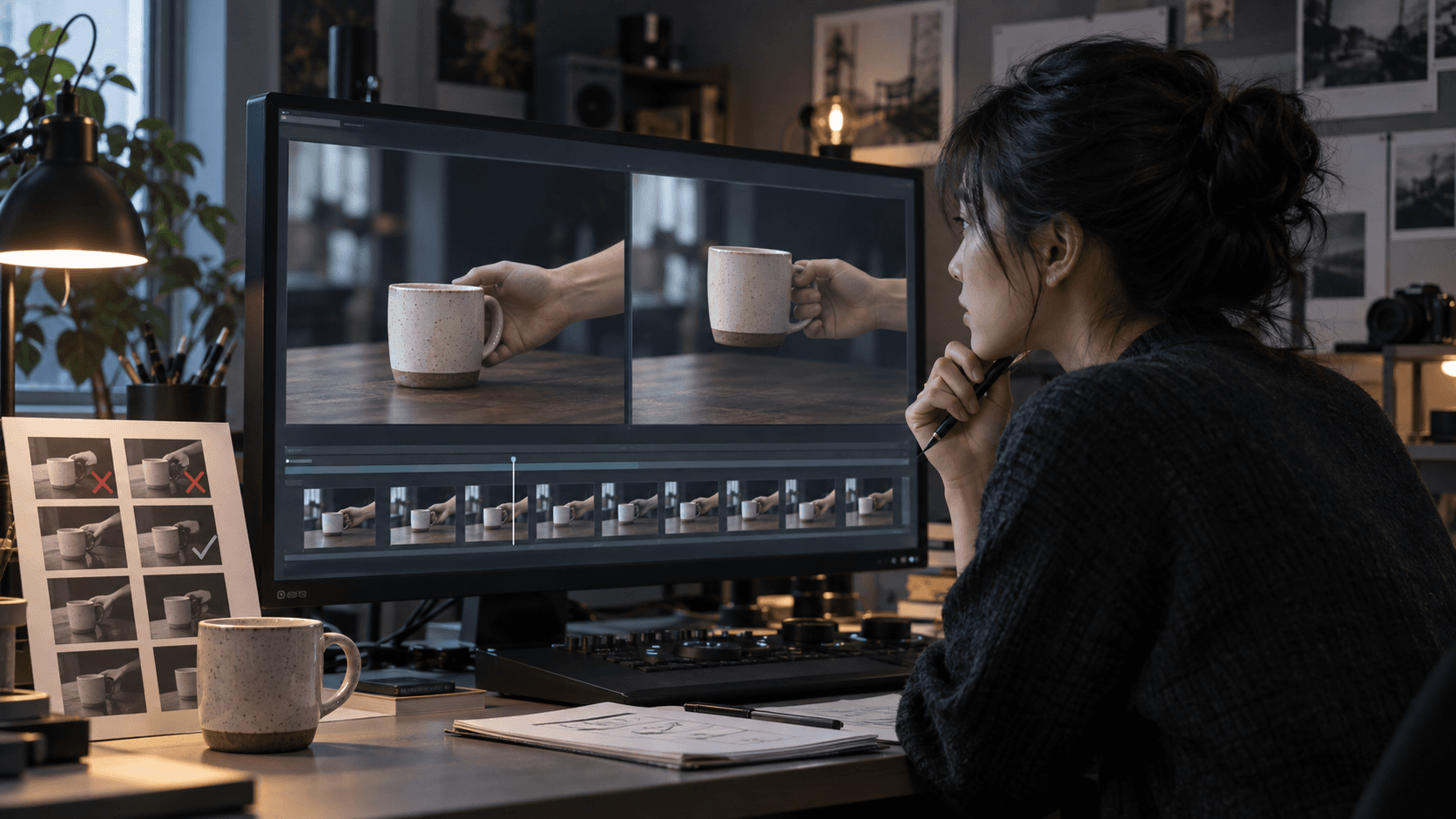
Do not regenerate the whole sequence first. Duplicate the rough cut in the APOB AI Video Editor and test repairs from least to most expensive. Log time, side effects, identity drift, and the cold-view result for each version.
Horizontal flip
Flip only when the shot contains no readable text, logos, asymmetric wardrobe, established light source, or recognizable room layout. Inspect hands and the parcel label at full size. A flip that fixes direction but mirrors evidence is not a fix.
Neutral bridge
Insert a truly neutral shot: a centered parcel close-up, a direct overhead, or a moment looking along the axis. The bridge gives viewers a new anchor without altering the surrounding shots. It costs screen time, so check rhythm as well as orientation.
Single-shot regeneration
Regenerate shot 4 from the permitted half-circle while locking the approved reference frame and prop coordinates. Preserve all other shots. Compare the replacement not just for direction but also face identity, clothing, light, and parcel design.
Sequence rebuild
Rebuild only when the wide anchor, movement vector, and close-ups disagree so broadly that local repairs create more defects. Return to the floor plan, not the existing outputs. A full rerender is the highest-cost option because every accepted detail becomes vulnerable again.
Repair | Minutes | Direction fixed | New side effect | Identity drift | Cold-view pass |
|---|---|---|---|---|---|
Flip | ___ | Yes / No | ___ | Low / Med / High | ___ |
Neutral bridge | ___ | Yes / No | ___ | Low / Med / High | ___ |
Regenerate shot 4 | ___ | Yes / No | ___ | Low / Med / High | ___ |
Rebuild sequence | ___ | Yes / No | ___ | Low / Med / High | ___ |
Export a continuity handoff sheet
The final asset is not merely a smooth video. It is a traceable handoff that tells the next editor which geography is intentional and which repair was accepted.
Shot identifier
Name each clip with scene, shot, version, and state: CAFE_S01_SH04_v03_APPROVED. Keep the generation date and model in metadata or the adjacent manifest. Never make the next editor infer which download is final.
Axis and eyeline status
Record same side, on axis, or crossed with reason, then pass/fail each eyeline pair. Add the approved anchor-frame thumbnail. The sheet should be readable without opening a generation project.
Repair owner
Assign the remaining action to one person: regenerate, bridge, edit, review, or approve. The APOB video-editing workflow supports assembly and practical repairs; frame-accurate finishing or advanced compositing may still belong in a dedicated desktop editor.
Final exception note
When discontinuity is intentional, preserve the reason: “Cross the axis on the alarm sound to destabilize the viewer; neutral overhead restores geography before dialogue resumes.” Adobe explicitly notes that discontinuity can serve story and mood. The note prevents a later reviewer from “correcting” the creative choice.
Completed handoff sample:
Shot ID | Axis | Eyeline | Action/prop | Repair | Owner | Exception |
|---|---|---|---|---|---|---|
CAFE_S01_SH01 | Same side | Pass | Parcel right hand | None | Director | Anchor |
CAFE_S01_SH02 | Same side | Pass | No move | None | Editor | — |
CAFE_S01_SH03 | Same side | Pass | Cup north-east | None | Editor | — |
CAFE_S01_SH04 | Crossed | N/A | Parcel center | Neutral bridge | Editor | Alarm disorientation |
CAFE_S01_SH05 | Same side | Pass | Exit rear-left | None | Director | Geography restored |
Use the rule as a diagnostic, not a commandment. Draw the axis, preserve the relationships, test the seam with people who lack your planning context, and repair only what actually breaks orientation. That turns continuity from a vague preference into a repeatable five-shot production decision.
Sources

Be the first to like this.








No credit card needed


