
Hedra alternatives are difficult to compare when every model receives a different face, motion, script, or review standard. A multi-model catalog may be convenient, while an owned persona workflow may reduce correction work. You cannot know which advantage matters until one locked character contract moves through both paths.
Create a reusable character anchor in APOB
This is a test protocol and blank audit board, not a report of fabricated generations. Hedra statements come only from Hedra’s official model and video pages; APOB statements come only from APOB product and help pages. Prices, credits, available models, and commercial terms were checked September 11, 2026 and must be rechecked before purchase or use.
Freeze the character contract
Create the contract before selecting a model. It should describe what the campaign needs, what cannot change, and how much correction is acceptable. Publish one approved still beside the rules so every reviewer starts from the same evidence.
Face anchors
Choose four or five stable features: face shape, eye spacing, eyebrow line, nose silhouette, mouth shape, hairline, or a distinctive mark. Use an adult subject you are authorized to represent. Save a front view and, if available, a three-quarter view.
Write reject thresholds in observable language. “Different person at normal playback” is too vague; “eye spacing, jaw shape, and hairline all drift from the approved still” is actionable. No tool should be described as guaranteeing perfect identity.
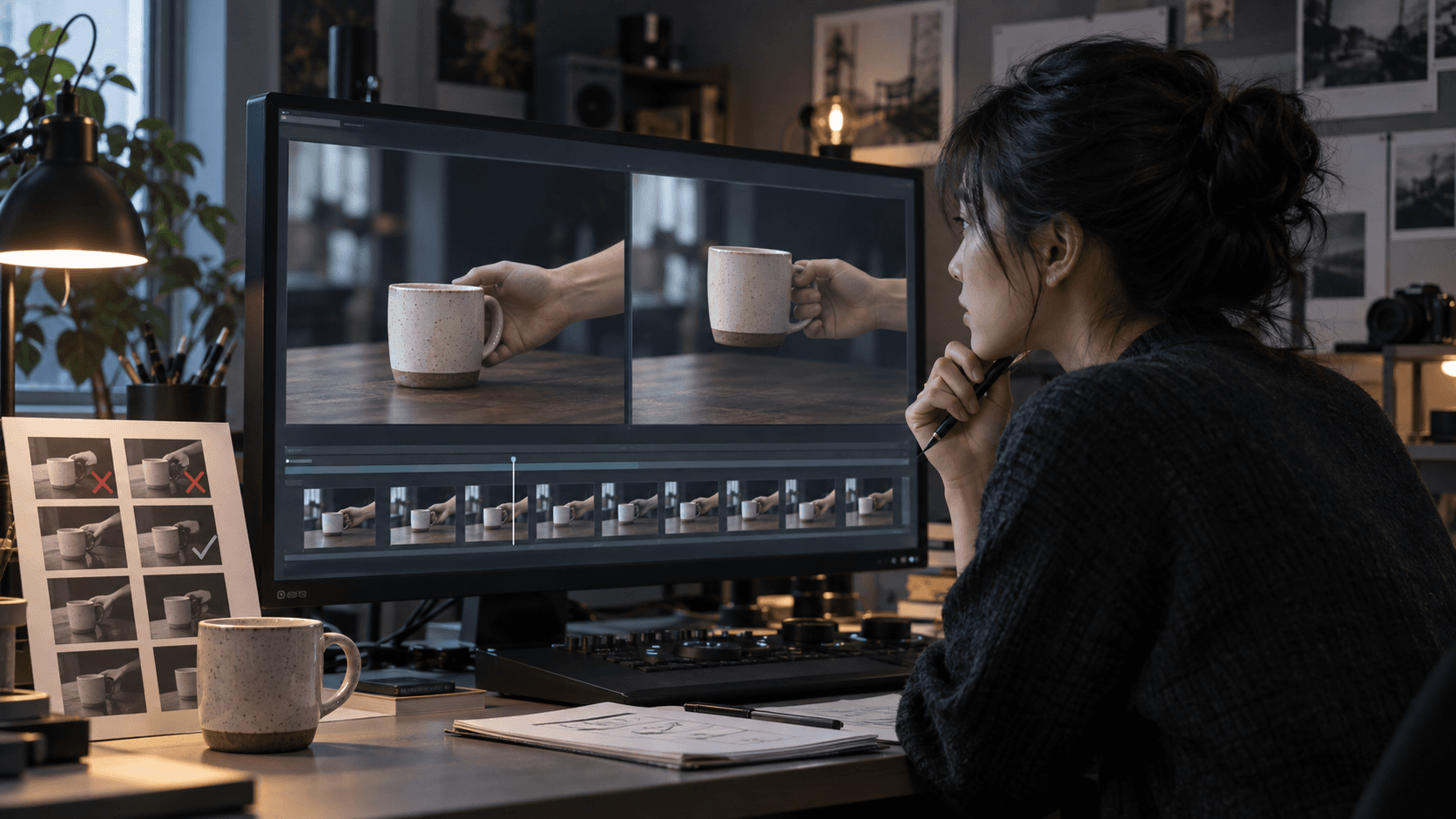
Add a viewing protocol: compare at normal playback, then pause at the beginning, peak motion, and final frame. Keep the display size constant. A face can look stable in one flattering still and drift during a turn, blink, or spoken phrase. The sampled frames make temporal change visible without pretending a handful of points represents every frame.
Wardrobe rules
List the outfit elements that must survive: jacket color, neckline, pattern, jewelry, glasses, and footwear when visible. Mark which details may vary. A model should not lose points for changing an unprotected accessory.
Include a wardrobe crop from the approved still. If the task calls for outfit change, freeze the before and after specifications separately rather than asking reviewers to guess what continuity means.
Product detail
Define the product’s shape, color, label, orientation, scale, and contact point. For branded work, keep a clean approved product reference and identify text that must remain legible. If a generated model cannot preserve required typography, route that element to compositing or a product-safe editing step.
Product fidelity belongs beside identity. A recognizable face holding the wrong package is not a usable campaign asset.
Reject threshold
Set separate thresholds for face, wardrobe, product, motion, voice, and correction time. Example: reject if two face anchors move, the product changes variant, hand contact becomes impossible, the spoken line changes meaning, or correction exceeds 20 minutes.
That time value is an editorial choice, not a vendor benchmark. Replace it with a threshold appropriate to your team. Record the reviewer, date, and evidence path.
Contract field | Required evidence | Pass | Reject |
|---|---|---|---|
Face | Approved still plus crops | Anchors recognizable | Two or more anchors drift |
Wardrobe | Color/detail list | Protected details intact | Campaign-critical detail changes |
Product | Reference and label crop | Shape/hue/label usable | Variant or claim becomes misleading |
Motion/voice | Brief and script | Intended action/meaning | Contact or meaning breaks |
Review time | Timer and notes | Below team threshold | Exceeds threshold |
Move the contract through Hedra's model shelf
Hedra’s official model directory presents video, image, and audio models within one studio and lists model-specific entry prices. That makes it relevant to a multi-model AI video test. Treat the catalog and rates as current vendor statements, not permanent facts.
Model choice
Select two contrasting paths based on the brief: one oriented toward character performance and another toward broader cinematic motion, for example. Record the exact model names, modes, displayed price or credit rule, resolution, duration, audio options, and date.
Do not assume every model supports the same inputs or rights. Hedra’s official AI video generator page describes a multi-model workflow and current plan positioning; verify the controls in the tested account.
Shared input
Send both paths the same approved still, script, scene description, aspect ratio, duration target, product reference, and protected-detail contract where the interfaces allow it. If a model requires a different input shape, log the transformation as handoff work.
Do not secretly improve one source. If the second path receives a repaired face or cleaner product crop, begin a new comparison row and preserve the earlier run.
Hash or precisely name the shared files, then keep a manifest with dimensions and crop. “Same character” is not enough when one model receives a full-resolution portrait and another receives a compressed screenshot. If an interface transforms the upload, capture the accepted preview and note that conversion as part of the path.
Control translation
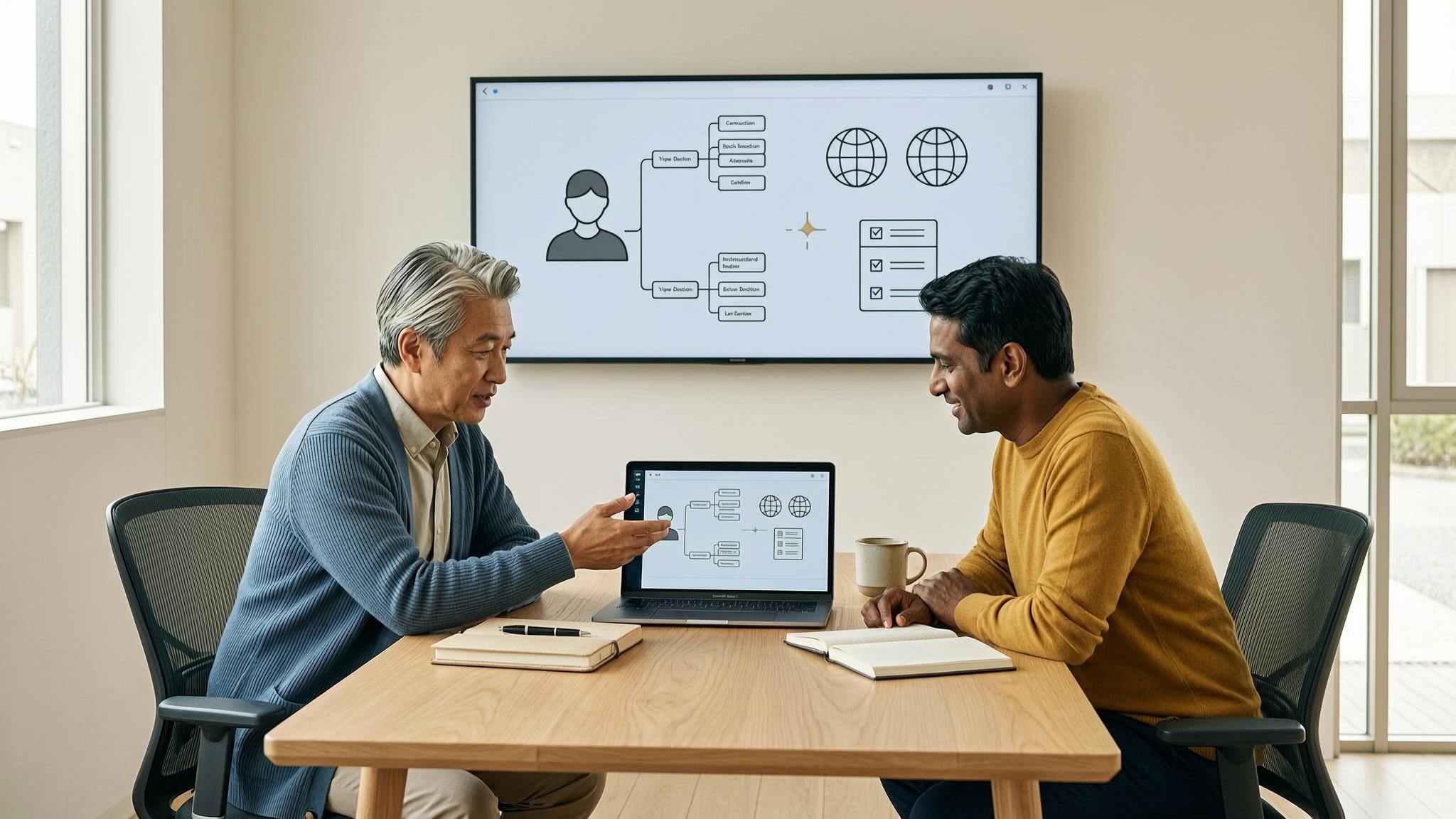
Create a control map with columns for contract field, Model A control, Model B control, missing control, and workaround. “Motion strength” in one interface may not mean the same thing as camera direction in another. Record labels exactly as displayed.
A shared studio reduces platform switching, but it does not prove semantic equivalence between controls. The audit should reward transparent translation, not the number of sliders.
Separate direct controls from prose workarounds. A dedicated duration selector is not equivalent to writing “a short clip,” and an image reference slot is not equivalent to describing a face. This distinction shows where reviewer effort moves when the model changes.
Output capture
Save the first complete output from each path before repair. Record generation date, job ID if available, displayed cost, input files, prompt, model, mode, and download filename. Keep rejected outputs.
The capture sheet is the baseline for the character consistency test. Do not call one model more consistent after selecting its best clip from a hidden batch and comparing it with another model’s first attempt.
Keep the contract inside APOB's persona path
The APOB path begins with a reusable portrait model, then moves through still approval and video generation. This is the central advantage to test when persona ownership and repeatable review matter more than browsing a large model shelf.
Portrait model
Create or select one approved persona in the APOB AI Influencer Generator. Store the authorized references, model name, approved hero portrait, face anchors, wardrobe rules, and prohibited uses. Do not mix references from different people to “improve” consistency.
The portrait model becomes a governed AI character generator asset. That does not guarantee every later frame; it gives the team a stable anchor and revision history instead of rebuilding the character for each clip.
Still approval
Generate the campaign’s key still first. Review face, wardrobe, product, composition, and disclosure space. Approve one image and freeze it as the motion input. If the still fails, repair it before adding video complexity.
Label the approval narrowly: “approved for test scene 01 at 9:16,” not “approved for all content.” Keep rejected stills and the reason each failed.
Run a small-thumbnail check before motion. If face, product, or disclosure space disappears at the intended feed size, fix the composition now. Video generation should not carry a weak still into a more expensive review stage.
Motion pass
Move the approved still through the APOB AI Video Generator. Select the displayed model and mode deliberately, then record the prompt, duration, aspect ratio, visible credits, and output. Protect face, product, wardrobe, action, camera, and script meaning.
The advantage is the continuity of the persona record and production workflow. Do not claim APOB automatically routes models or eliminates review. Score what appears in the actual output.
Revision record
Repair one failure per pass. If the face is stable but the hand-product contact breaks, adjust only the action or reference that addresses contact. Keep the original prompt and output beside the revision.
APOB’s official credits, plans, and billing guide notes that offers and credit mechanics can vary. Record what the account displays; do not generalize a single bill into universal Hedra pricing or APOB cost claims.
Score drift where reviewers actually spend time
Do not compress the audit into “visual quality.” A clip can be sharp yet expensive to review, or slightly imperfect yet easy to repair. Score the failure classes and reviewer minutes separately.
Identity drift
Compare the same sampled frames against the approved portrait. Score face anchors, hairstyle, age presentation, skin details, and temporal stability. Write a timecode for every material change.
Use a five-point scale: 5 means all protected anchors remain recognizable through sampled moments; 3 means one bounded drift requires review; 1 means the character reads as another person. Preserve the individual scores instead of hiding disagreement in an average.
Brand drift
Check wardrobe, product color, label, logo, required text, disclosure space, and set design. Brand drift can be more commercially damaging than subtle facial variation. Mark whether the defect began in the source, generation, or editing handoff.
If typography must be exact, use a controlled finishing step. Neither model catalog nor persona workflow should be credited for a claim the source pages do not make.
Score brand elements independently when one failure can invalidate the asset. Face 5, wardrobe 5, and product 1 should not average into a “good” result. Use hard gates for legally or commercially required details and descriptive scores for aesthetic preferences.
Motion fit
Score whether the action serves the brief, contacts are plausible, camera behavior is intentional, and voice or audio retains meaning where used. A character can remain visually stable while performing the wrong action.
Review at normal speed and on sampled frames. Do not reward slow motion simply because it hides defects.
Use the same performance brief for every path: action start, contact moment, emotional beat, spoken line, and camera behavior. Mark each as pass, partial, or fail. When one model cannot accept a particular control, score the resulting handoff effort instead of silently simplifying that path’s assignment.
Review minutes
Start the timer when the output opens and stop after accept, repair brief, or reject. Record inspection, discussion, rerun setup, generation wait only if your policy counts it, editing, and approval separately.
The lowest-review workflow is not automatically the cheapest or fastest generator. It is the path that produces an acceptable master with the least bounded human work for this contract.
Path | Face drift | Brand drift | Motion fit | Review minutes | Attempts | Verdict |
|---|---|---|---|---|---|---|
Hedra Model A | Accept / repair / reject | |||||
Hedra Model B | Accept / repair / reject | |||||
APOB persona path | Accept / repair / reject |
Select a home for the character—not every model
Choose the operating home that protects the contract and fits the team’s review capacity. A conditional result is more useful than declaring an overall winner from one scene.
Hedra-first condition
Choose Hedra first when the tested project benefits from rapid access to contrasting model families, the team is comfortable translating controls, and the shared-input runs meet identity, brand, motion, rights, and review thresholds. Recheck the current model catalog, plan, rate, and commercial-use language before committing.
Hedra’s breadth is the tested advantage. It should not receive credit for perfect consistency or identical controls across models unless your evidence shows it.
APOB-first condition
Choose APOB first when the long-lived asset is the persona, reviewers want a stable approved portrait before motion, and the team benefits from keeping influencer creation, still approval, video generation, and editing close together. The AI Influencer Generator is especially relevant when campaign continuity outweighs model browsing.
APOB still requires authorization, quality review, and explicit publishing. Its advantage here is the owned-persona production lane, not a promise that every output passes.
Controlled handoff
Use both only when the contract can cross the boundary without losing evidence. The packet contains approved still, prompt, script, protected details, product reference, allowed transformations, aspect ratio, duration, rights note, and reject threshold. Name the receiving model and version.
Do not pass only a compressed image and a sentence. Every missing field becomes a silent creative decision downstream.
Require a return packet as well: selected model, actual controls, output IDs, rejected frames, repair notes, cost display, reviewer decision, and any term or plan check performed. A handoff is controlled only when evidence can travel back to the character owner.
Retest event
Re-run the same scene when a model, input limit, plan, price, credit rule, commercial term, APOB persona workflow, or campaign threshold changes. Freeze the current board and create a new dated row.
The final decision should read: “Hedra-first,” “APOB-first,” “controlled handoff,” or “neither,” followed by the evidence and review budget that justify it. Save the versioned character contract with the decision. That makes future Hedra alternatives easier to evaluate without starting from a marketing checklist.
Archive the raw sources and terms snapshot with the board. If the next test uses a different face, scene, or reviewer threshold, label it a new case rather than overwriting the first. Comparable history is more valuable than a permanently changing winner.
Sources

Be the first to like this.







No credit card needed


